

On Friday night a multi-agency team of Directorate of Criminal Investigations detectives from Laikipia and Kenya Wildlife Service officers from Nairobi and Laikipia executed a search warrant at the residence of Ol Pejeta Conservancy chief executive Justin Heath and at the conservancy armoury. What they recovered has turned one of Kenya’s most celebrated private conservation institutions into the centre of a criminal investigation.
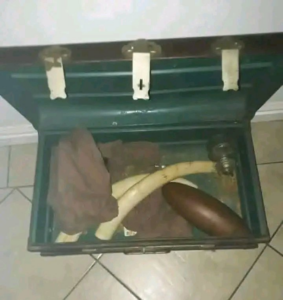
Officers found two elephant tusks weighing 31.10 kilogrammes and 28.50 kilogrammes, valued at approximately KSh 3.2 million. They also recovered a dried lion skin. Both items were located in the conservancy armoury. Neither had been reported to the Kenya Wildlife Service, and neither appeared in the conservancy’s own records. The lion skin had not been surrendered within the legally required 72-hour window. In the boot of a vehicle parked at Heath’s residence the team found 1,465 rounds of 12-bore ammunition. Heath reportedly told investigators he had forgotten the ammunition while travelling to the United States. He could not produce purchase receipts. The ammunition was not listed on the conservancy’s firearms certificate.
Heath was placed in custody. He faces allegations of possession of wildlife trophies belonging to endangered species without a permit or exemption certificate issued by the Director-General of the Kenya Wildlife Service, contrary to Section 92(4) of the Wildlife Conservation and Management Act. Investigations continue. The tusks are being held at the KWS station in Nanyuki. The ammunition is secured at Nanyuki Police Station. Heath has not been convicted. The allegations have not yet been tested in court.

The facts on the ground are nonetheless stark. The man who has led Ol Pejeta since April 2022 was found with unregistered ivory and a lion skin stored inside the very institution charged with protecting those species, plus a large quantity of ammunition whose origin he could not document. For a conservancy that has spent years presenting itself as a model of professional wildlife protection, the recovery is difficult to reconcile with the public narrative.
Ol Pejeta occupies roughly 90,000 acres of former colonial ranch land, originally associated with Lord Delamere and later Adnan Khashoggi. It was acquired in 2004 by Fauna & Flora International with major funding from the Arcus Foundation and converted into a land trust. It markets itself as a non-profit model held in trust for Kenyans while generating substantial revenue from tourism and livestock. It holds the largest black rhino population in East and Central Africa and the last two northern white rhinos. Between February and November 2026 the conservancy reported 17 black rhino deaths, attributed to predation, age, disease, drowning and other causes, some unexplained. Its eastern black rhino numbers sat well above the estimated carrying capacity of the habitat. A Kenya Wildlife Service audit was already under way when the arrest occurred.
The presence of undocumented tusks and a lion skin in the armoury, together with uncertified ammunition at the chief executive’s residence, raises direct questions about chain of custody, internal controls and compliance. Strict reporting and certification rules exist precisely to prevent trophies and weapons from drifting into illegal trade or from being held without accountability. When those rules appear not to have been followed inside a flagship conservancy, the gap between the conservation claim and the operational reality becomes hard to ignore.
Heath’s background includes earlier work with Seiya Limited, a company that has provided management services to several conservancies, including sites in the Mara. He has described joining the family business running conservation areas in the Maasai Mara early in his career. Those connections do not prove wrongdoing elsewhere. They do place the current case inside a wider network of private and public-private conservation operations that control significant wildlife habitat, generate tourism income and attract philanthropic capital while operating under relatively light day-to-day public scrutiny.
Kenya’s wildlife is public property. Institutions entrusted with it are not exempt from the laws they invoke to police others. The recovery of ivory, a lion skin and more than a thousand rounds of ammunition from the residence and armoury of Ol Pejeta’s chief executive does not by itself prove a broader trafficking network. It does demonstrate that the systems meant to prevent exactly this outcome failed at the top of one of the country’s most prominent conservancies. That failure is now a matter of public record. Whether it is an isolated lapse or a symptom of deeper problems in how private conservancies account for the wildlife and weapons under their control is the question the investigation, and the public, must now answer.
There's no story that cannot be told. We cover the stories that others don't want to be told, we bring you all the news you need. If you have tips, exposes or any story you need to be told bluntly and all queries write to us [email protected] also find us on Telegram
