
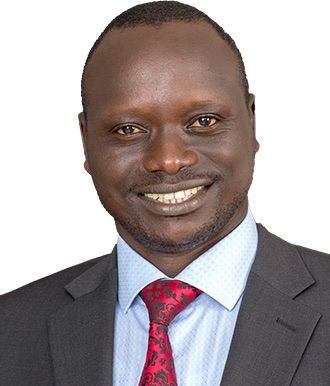
He does not hold the big office. He does not cut the ribbon. On paper Lawrence Chelimo Kibet is a Director General, one technocrat among several at the National Treasury. In the corridors, where the cameras do not work, they tell a different story. The Cabinet Secretary signs. The Principal Secretary performs. The quiet man from Baringo decides.
The whisper has a name for him. The supremo. It is not written in any gazette. It is not printed on a door. It is passed between fixers, board clerks and political aides who have watched who stays in the room after the press is walked out.
The paper job that feeds the whisper
In May 2023 the Treasury appointed him Director General of Public Investments and Portfolio Management. He came straight from the chief executive’s chair at Image Registrars, the firm that keeps share registers and company-secretarial files for listed Kenya. Victoria Cherotich took over that firm from April 2023. Kibet took the state’s ownership desk.
The brief is not small. Government investments. Public enterprises. Assets and liabilities. Public investment management. Government pensions. In plain language, the file on what the public still owns, and what it is about to sell.
Before the state job he was already inside the companies. In November 2021 KenGen named him, registration number 2698, as the Image Registrars representative for its secretarial work. Filings tie him to secretarial roles at Rubis, formerly KenolKobil, from 2016, at Sasini until March 2023, and earlier at Standard Group and Nairobi Business Ventures. The man who drafted the board papers walked into the office that oversees the state’s stake in the same economy.
Some commercial databases still list him as Image Registrars chief executive and as a director at SMEP Microfinance. The firm itself announced his exit, so those listings look stale. The door still revolves. In May 2026 Kenya Airways moved its share registry to Image Registrars.
The credentials are tidy. A Bachelor of Commerce in finance, a law degree and an MBA, all from the University of Nairobi. A public-policy programme at Strathmore, with a module at New York University’s Wagner School. Membership of ICPAK, the Institute of Certified Public Secretaries, the Law Society of Kenya and the Investor Relations Society in the UK. Accountant. Lawyer. Company secretary. That combination is the method.
Same countryside, a State House honour
Safaricom lists him as Mr Lawrence Kibet, EBS, alternate director to the Cabinet Secretary for the National Treasury and Economic Planning. Elder of the Burning Spear is not a seminar certificate. It is a State House decoration.
Baringo platforms already call him a son of the county. President William Ruto is from Sugoi in Uasin Gishu. Not the same constituency. The same political countryside. In this administration, that has been enough to place a loyal professional where the paper moves. Nobody has minuted him as Ruto’s man. The corridor does not need a minute.
The port poster Treasury called fake
On 6 October 2026 a document dressed as a Business Registration Service extract tore through social media. It styled Kenya Ports Authority as Kenya Ports Authority PLC. It put a nominal capital of Sh10 billion on it, ten million ordinary shares at Sh1,000 each. It named Cabinet Secretary John Mbadi as director and shareholder, Principal Secretary Christopher Kiprotich Kiptoo as director, and Lawrence Kibet as company secretary, with registry records said to be as of 6 August 2026.
Treasury stamped the poster fake the same day and told the public to ignore it.
The disclaimer did not kill the talk. KPA’s own website now calls the authority a public limited company established under the Government Owned Enterprises Act, No. 25 of 2025. It lists Mr Lawrence Kibet as an alternate director, beside the Principal Secretary for Transport. Stephen Mutoro of the Consumer Federation of Kenya looked at the three Treasury names and said the quiet part out loud. Of the three, he wrote, it is company secretary Lawrence Kibet, the accountant and the lawyer, who calls the shots. The other offices, he said, are large, and mostly public relations.
That is grapevine, not a board minute. It is also the line now moving through Nairobi. A market account asked why a circulating extract would list Kiptoo and Kibet as the names that matter when other directors sit on the public board. The suspicion in that question is the old one. A thin register is useful when someone wants to sign what the full board should see.
The law that parked the assets at Treasury
The Act was assented to on 21 November 2025 and commenced on 5 December 2025. It reconstitutes government-owned enterprises as companies, transfers assets, liabilities and businesses into that form, and parks ownership with the national government through the National Treasury.
COFEK sued in a petition dated 28 January 2026. It argued the law was passed without proper public participation and handed the Cabinet Secretary sweeping control of public commercial assets. On 7 August 2026 the High Court dismissed the petition and upheld the Act. Mutoro still calls the statute unconstitutional and too hot for the judiciary. The court record says he lost.
What the court did not settle is the political fear. Once a port, a pipeline or a telco sits in a company whose shares are held in the name of whoever occupies Treasury, a later Cabinet can move those shares with ordinary company machinery. The title is institutional. The hands on the file are personal. Kibet’s name is on the board list.
Four chairs, one officer
On 8 July 2026, by gazette notice under section 13 of the National Infrastructure Fund Act, Mbadi appointed six directors for three years. Four were named as independent directors, among them Centum chief executive James Mworia. Two were named as public officers. One of those two was Lawrence Kibet.
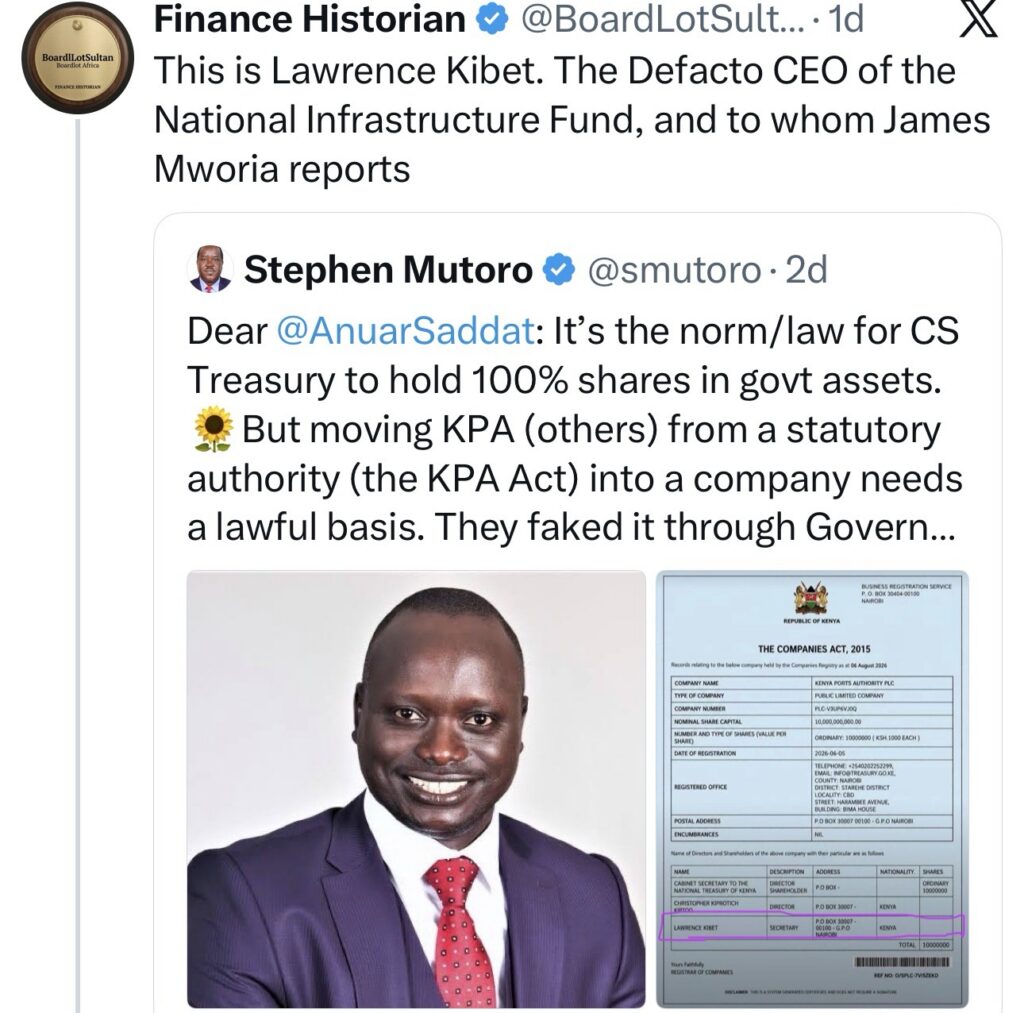
Within hours a market account called him the de facto chief executive of the fund, and the man Mworia reports to. That is a characterisation, not an organogram. What is on the record is colder.
The fund’s seed capital is the Sh103.45 billion the state booked from the partial sale of Kenya Pipeline Company.
The next expected inflow is the Safaricom divestiture, pitched at about Sh200 billion plus an upfront dividend substitute, a package courts have frozen at roughly Sh244.5 billion while petitions run. Kibet sits on the Safaricom board as Treasury’s alternate director, while his docket watches the shareholding being sold into the fund he helps direct.
Oversight. Seller. Board member. Recipient. Four chairs. One officer. Nobody has written him down as the boss. Everybody who needs a decision seems to know whose corridor to walk.
The salesman for the sale
He has been the public face as well as the file. At the Kenya Pipeline IPO launch he stood with PS Chris Kiptoo as the state offered 65 percent of KPC at Sh9 a share and promised to keep 35 percent as a strategic investor. He told a Privatisation Authority interviewer that the private sector had come of age and could run commercial services better than government.
On Citizen TV in March 2026 he defended a Sh17 billion State House allocation. Dome tents, he said, had been costing nearly Sh80 million a week. The build would pay back in about six and a half years.
He could look the country in the eye and call it value for money. Inflation, he said, had fallen from 9.6 percent when this government arrived to about 4.5 percent. The public does not experience Treasury from the inflation print. It experiences it from the asset register.
The question the ministry has not answered
Mutoro has since asked why Kibet is still a director of a private company while he is Director General at a Treasury that oversights the Insurance Regulatory Authority.
A reply wondered whether the law even bars it, so long as he declares the interest. That is the comfort fixers like.
The integrity rules were written for the officer who insists the seat is harmless. Until he publishes the resignation, the declaration, or the company, the question sits in the corridor with the rest.
No charge sheet has named him. No auditor-general query has made him the headline. That is the method.
The noise attaches to the sale, the Act, the frozen Safaricom cheque, the port turned into a company, the fund seeded with pipeline money. The officer who touches all of them remains a director general, an alternate director, a fund board member, an EBS, and a son of Baringo who learned the market from inside the register.
Ruto does not need him on the podium. The whisper says he needs him on the file. The file is where the ports, the pipeline, the telco and the pensions now live. And in the rooms where the cameras are off, they do not say Mbadi. They say Kibet.
There's no story that cannot be told. We cover the stories that others don't want to be told, we bring you all the news you need. If you have tips, exposes or any story you need to be told bluntly and all queries write to us [email protected] also find us on Telegram
