
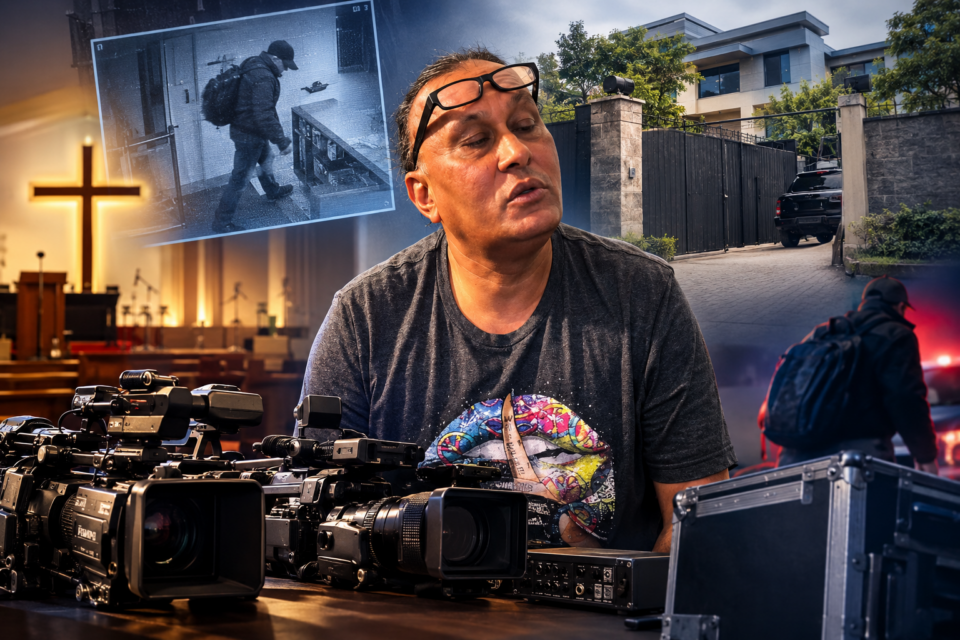
For years, the theft of cameras and other high-end production equipment from churches, journalists, musicians and content creators has appeared to be a collection of unrelated crimes.
But a series of recent incidents is beginning to suggest a more organised and lucrative underworld, one in which the person who steals the equipment may be only the first link in a much longer chain.
At the centre of the latest questions is Nairobi businessman Ashish Shah, whose name has repeatedly surfaced in allegations concerning the handling of stolen cameras, laptops, mixers and other professional electronics.
The latest trail begins before dawn at a church in Donholm.
On August 2, 2026, CCTV footage showed a man identified as David Simiyu entering the church at about 5:43am, when the sanctuary was empty and Sunday service was still hours away.
According to an investigation published by The Standard, Simiyu went directly to the church media store, retrieved a hidden key and spent about 11 minutes removing five professional broadcast cameras and an audio interface card. The equipment was valued at more than Sh2.1 million.
The remarkable part was not simply how easily the equipment disappeared.
It was where the trail allegedly went next.
Television footage reviewed in connection with the investigation reportedly followed the suspect to a Parklands compound described as belonging to Shah.
That development has placed Shah under renewed scrutiny, particularly because his name had already surfaced weeks earlier after another piece of stolen professional equipment was recovered from a Parklands property linked to him.
The Parklands connection
On July 7, DJ Macdee reported that his Pioneer DJM-S11 mixer had been stolen after his vehicle was broken into.
Weeks later, the same model appeared for sale online at Sh280,000.
Macdee, working with officers from Mugutha Police Station, traced the advertisement to a seller identified as DJ Mkenia. The trail eventually led investigators to a Parklands residence associated with Shah Ashish.
The mixer was recovered and, according to Macdee, its serial number matched the number on his original purchase receipt. Other electronics, including televisions, speakers, generators and other equipment, were also reportedly found at the premises.
Shah was subsequently charged in connection with the theft of a Pioneer DJM-S11 mixer valued at Sh327,000. Citizen TV’s August 20 report, carried by KenyaMOJA, identified him as the accused in the case.
He denied the charge.
But the recovery changed the conversation.
It was no longer simply about thieves breaking into vehicles or churches. Investigators were now confronted with a more important question: where do stolen professional electronics eventually go?
Macdee has also questioned the circumstances surrounding Shah’s release from police custody after the recovery, saying he was not informed before the release. Those claims have added to public scrutiny of how the investigation was handled.
A name that had surfaced before
Shah’s name did not emerge from nowhere.
In 2023, journalist and activist Boniface Mwangi publicly accused him of being a major receiver of stolen cameras and laptops.
Mwangi alleged that stolen professional equipment had for years been channelled through an East African network involving Kenya, Uganda and Tanzania. He further alleged that stolen equipment belonging to journalists had previously ended up in Shah’s possession.
Those are allegations, not findings of a court.
But they have acquired renewed attention because of the recent recovery of Macdee’s mixer at a Parklands property associated with Shah and the subsequent Donholm camera trail.
The allegations are therefore now being examined against a series of physical recoveries and CCTV trails rather than in isolation.
The church thief who knew exactly what to steal
The man alleged to have carried out the Donholm theft is also not new to investigators.
David Simiyu Wanyonyi was arrested in connection with earlier church camera thefts.
In March 2022, DCI detectives investigated the disappearance of two professional cameras from PCEA Zimmerman Parish. The equipment, valued at about Sh1 million, was traced to dealers at Nairobi’s Imenti business hub and recovered. Contemporary reports identified Simiyu as the suspect and said three alleged dealers were arrested in connection with the equipment.
Then, in December 2024, Simiyu appeared before Milimani Senior Principal Magistrate Dolphina Alego.
His account was extraordinary.
He admitted stealing cameras from churches and selling equipment worth hundreds of thousands of shillings for as little as Sh50,000.
He told the court that he had targeted churches including CITAM, Christian Fellowship Foundation in Kiambu and Redeemed Gospel Church. Reports of the proceedings said he would enter congregations as an ordinary worshipper and gain access to church media operations.
One of the cases involved equipment stolen from CITAM Valley Road in November 2023, with the value of the stolen equipment reported at about Sh1.7 million.
The revelation exposed the economics of the trade.
A camera worth more than Sh500,000 could allegedly be moved for a fraction of its legitimate value.
For the thief, it is quick cash.
For the receiver, the calculation can be very different.
A sophisticated camera, mixer or lens has a ready market. It can be resold, stripped for parts, moved across borders or passed through several intermediaries before its original owner has even finished filing a police report.
Why churches?
Churches have become an increasingly attractive target because their media departments can contain equipment worth millions of shillings in rooms that are not necessarily protected like banks or commercial warehouses.
The equipment is also highly portable.
A thief does not need to dismantle a building. He needs only to identify the right camera, lens, mixer or computer and get out.
The Donholm incident illustrates the apparent precision.
The suspect allegedly knew where the media equipment was kept.
He allegedly knew where a key could be found.
And rather than ransacking the church, he allegedly concentrated on professional broadcasting equipment.
That raises an uncomfortable question for investigators: was the theft opportunistic, or was the suspect working within a network that already knew what the equipment was worth and where it could be moved?
The Mwafreeka trail
Another case from 2026 shows how quickly stolen production equipment can disappear from Kenya.
In April, podcaster Mwafreeka, also known as Makarios Ouma, reported the theft of two Sony A7 IV cameras, lenses and stands from his Iko Nini studio.
The equipment was estimated at about Sh1.1 million.
CCTV footage captured the break-in, while the thieves appeared to ignore computers and concentrate on equipment that could be sold quickly.
The subsequent investigation reportedly led to four suspects, including two Tanzanians, with part of the trail extending into Tanzania and Arusha.
Mwafreeka later reached an out-of-court settlement and recovered a substantial portion of his loss.
Importantly, his account does not identify Shah as the purchaser of that equipment.
That distinction matters.
The case nevertheless illustrates how stolen cameras can quickly cross jurisdictions, change hands and disappear from the original crime scene.
The bigger question
The question facing investigators is therefore not simply whether individual thieves can be arrested.
It is whether Nairobi has developed a sophisticated market for stolen professional electronics in which the person breaking into a church is the least important player.
Simiyu’s history demonstrates that there is a ready supply of thieves willing to steal cameras for comparatively little money.
The recent Parklands recovery demonstrates that stolen professional equipment can also be traced to established premises.
The allegations by Mwangi provide another layer, pointing to claims that the same name has circulated in connection with stolen cameras and laptops for years.
And the 2026 recovery of Macdee’s mixer has placed the issue directly before the courts.
Taken together, the episodes raise questions that investigators will have to answer with evidence rather than speculation.
Who receives the equipment?
Who finances the thefts?
Who removes serial numbers or identifying marks?
Who moves the equipment across borders?
Who resells it?
And, most importantly, who is making money at the top of the chain?
A long paper trail
There is also a documented court history involving a person named Ashish Shah dating back to 2012.
In Ashish Shah v Republic, the High Court at Nairobi dealt with a criminal matter in which a warrant of arrest had been issued after the applicant failed to appear before a lower court. The ruling records arguments concerning his absence, bond and subsequent arrest. The court ultimately declined to grant the orders sought and directed that the criminal case be heard expeditiously.
That record should not, by itself, be treated as evidence that Shah committed the current allegations. Court records can involve people with identical or similar names, and the existence of an old criminal matter is not proof of guilt in a new case. The available case listing itself carries such a caution.
What makes the historical record relevant now is simply that the name is not entirely new to Nairobi’s criminal justice system.
The unanswered questions
For churches losing millions of shillings in cameras, the stakes are enormous.
These are not merely gadgets.
They are the equipment through which congregations broadcast services, preserve sermons, run online ministries and reach worshippers outside their physical buildings.
When five cameras disappear in 11 minutes, a church can effectively lose its digital ministry overnight.
The thieves may receive a fraction of the equipment’s value.
Somebody further down the chain can potentially make considerably more.
That is why the Donholm CCTV trail deserves more than another arrest at the bottom of the chain.
If investigators can establish that the equipment was indeed delivered to a Parklands property associated with Shah, they will have a potentially significant evidentiary lead.
If the recovered Macdee mixer is connected to the same network, that would provide another piece of the puzzle.
But the ultimate test will be forensic: serial numbers, CCTV footage, phone records, transaction records, ownership documents, statements from suspects and buyers, and a documented chain of custody.
Until then, Shah remains a person of interest amid allegations and an ongoing criminal case, not a proven mastermind of a church-theft syndicate.
What investigators must now establish is whether the repeated appearance of stolen professional equipment around the same circle is coincidence, or evidence of a much larger operation.
For Nairobi’s churches, the answer could determine whether the people stealing from their media rooms are merely opportunistic thieves, or foot soldiers in a sophisticated market with powerful receivers waiting at the other end.
There's no story that cannot be told. We cover the stories that others don't want to be told, we bring you all the news you need. If you have tips, exposes or any story you need to be told bluntly and all queries write to us [email protected] also find us on Telegram
