

A German technology entrepreneur came to Kenya with patents, artificial-intelligence expertise and a plan to build a solar-energy business.
Months later, Hannes Bend says he was left with unpaid work, unauthorised charges of about $52,000 on his personal cards, disputed equity and recordings of telephone calls in which he alleges VeGrid CEO Thomas Mboya Ogutu threatened him with deportation and physical harm.
Then came the allegation that turned a private commercial dispute into a potentially explosive governance story.
Bend says documents he obtained linked Charles Korgoren Kerich, the former Nairobi County Executive Committee Member for Finance and Economic Planning, to the ownership of VeGrid and its US-linked vehicle, VeGriddy Inc.
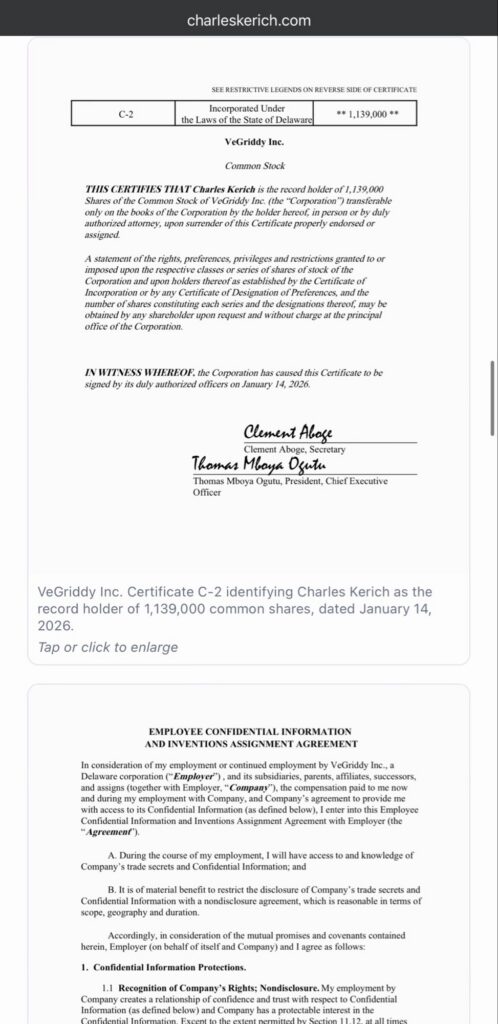
Publicly available corporate material now circulating in connection with the dispute identifies Kerich as the holder of 1,139,000 shares in VeGriddy Inc., equivalent to about 13.4 per cent of an 8.5 million-share issuance. The same documents identify Ogutu as the holder of 5.355 million shares.
Bend’s account puts the wider disputed value at approximately Sh38.9 million, although the most clearly documented cash component is the roughly $52,000 in alleged unauthorised card charges. The larger figure includes the value he assigns to work, promised equity and other losses. No court has yet awarded Bend Sh38.9 million.
The allegations have not been proved in court.
But the documents, the corporate records, the recorded conversations described by Bend and Kerich’s separate court battle over a Sh106.7 million decree have created a combustible trail that raises questions about corporate ownership, public-office conflicts and the treatment of a foreign investor who says he tried to report threats to Kenyan authorities.
The German investor who arrived with technology, not politics
Bend is an entrepreneur associated with Breathing AI and other artificial-intelligence ventures.
His account is that he became involved with VeGrid towards the end of 2025 and contributed to the company’s digital and commercial development, including work on its website, pitch material, business plan and growth strategy.
VeGrid describes itself as a solar power-as-a-service company whose VESPMAN platform coordinates financing, deployment, monitoring and payments for distributed solar projects.
The company publicly identifies Ogutu as its founder and CEO and says he has more than three decades of experience in technology and energy, including senior roles at Kenya Power and the Postal Corporation of Kenya.
Bend says he was promised an equity interest for his contribution and also helped establish the company’s US-linked corporate structure.
Instead, he alleges, his personal credit cards were used for transactions he had not authorised, eventually leaving him with approximately $52,000 in charges.
When he demanded payment and formal documentation of his interest, he says the relationship collapsed.
What followed is the most serious part of his account.
From business disagreement to alleged threats
Bend has publicly released portions of telephone conversations that he says were recorded in March 2026.
He alleges the calls were with Ogutu and included threats involving deportation and physical harm.
One recording publicised by Bend contains the words: “Otherwise you’ll get deported. Uh huh. Take it from me. Okay.”
The recording and the wider allegations have subsequently been reported by Kenyan media. Kenyan Hour reported that Bend said he had reported the matter to police after officers visited his Nairobi residence but that no arrest followed. It also reported his claim that he later approached the Directorate of Criminal Investigations and complained that no meaningful forensic investigation had been undertaken.
Kenya Insights similarly reported Bend’s allegation that he had gone to the DCI repeatedly and that, months after reporting the alleged threats, forensic evidence had not been collected.
Those are Bend’s allegations. They are not findings by a court.
But they transformed what might ordinarily have been a shareholder or compensation dispute into a matter involving alleged intimidation and the response of law-enforcement agencies.
Then Charles Kerich appeared in the ownership trail
The most consequential development came when Bend began publishing documents he says established a connection between Kerich and the solar venture.
A corporate resolution attributed to VeGriddy Inc. records an issuance of 8.5 million shares.
The allocation listed in the publicly circulated documents is:
- Thomas Mboya Ogutu: 5,355,000 shares, or 63 per cent
- Dennis Volemi: 1,615,000 shares, or 19 per cent
- Charles Kerich: 1,139,000 shares, or approximately 13.4 per cent
- Clement Aboge: 85,000 shares, or 1 per cent.
A separate stock certificate identifies Kerich as the holder of 1,139,000 VeGriddy Inc. common shares.
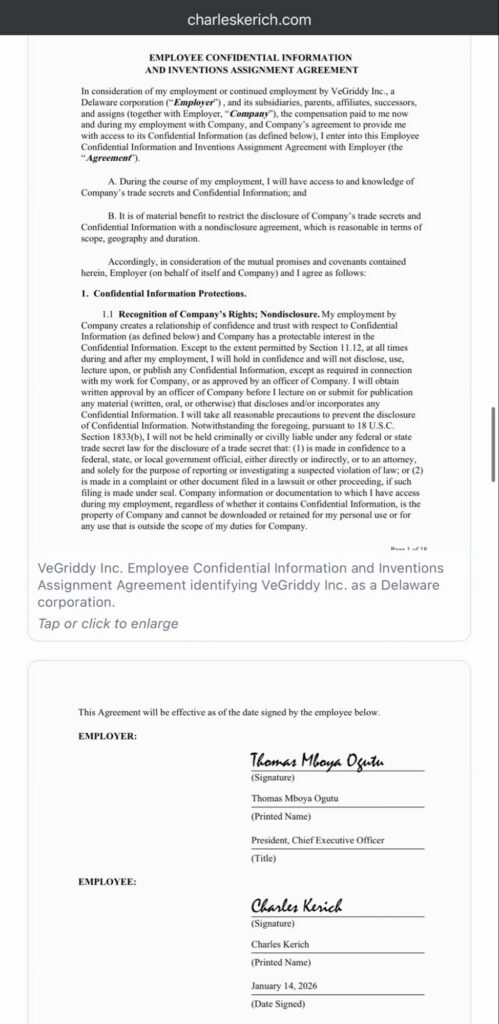
The documents also contain an employee confidentiality and inventions agreement bearing Kerich’s name and a signature page dated January 14, 2026, with Ogutu identified as president and chief executive officer.
That distinction matters.
Bend has publicly described Kerich’s interest as roughly 20 per cent in the wider VeGrid structure. The US corporate documents reviewed in public reporting, however, show a 13.4 per cent allocation in the specific 8.5 million-share VeGriddy issuance.
The two percentages should therefore not be treated as interchangeable.
What the documents do establish, subject to verification of their authenticity and legal effect, is that Kerich’s name appears in corporate records connected to the US vehicle alongside Ogutu.
That is materially different from a mere allegation based on a WhatsApp message.
A public officer with a private energy interest?
The Kerich connection becomes more consequential because of the office he occupied.
Before his suspension, Kerich was Nairobi’s CEC for Finance and Economic Planning.
Article 75 of the Constitution requires State officers to conduct themselves in a manner that avoids conflicts between personal interests and public duties. Article 77 provides that a full-time State officer must not participate in other gainful employment. The Leadership and Integrity Act similarly addresses gainful employment and conflicts of interest.
The existence of a shareholding does not, by itself, establish that Kerich violated those provisions.
But if the corporate documents are authentic and the interest existed while he was a full-time county executive, they create an obvious question for the relevant ethics and investigative authorities: what was the nature of Kerich’s relationship with VeGrid, when did it begin, what consideration was paid for the shares, and was the interest declared?
Those questions are especially significant because VeGrid operates in the energy sector and Nairobi County is a major commercial and institutional market.
Kerich’s separate court battle adds another layer
The VeGrid allegations emerged as Kerich was already fighting a major legal battle over his conduct as Nairobi’s finance chief.
On May 19, 2026, Justice Francis Gikonyo committed Kerich to three months in prison for contempt after he failed to comply with court orders relating to Sh106.7 million in legal fees.
The Standard reported that the court subsequently ordered him to surrender to Industrial Area Remand Prison after declining to suspend the sentence.
Governor Johnson Sakaja suspended Kerich on June 5 and appointed Ibrahim Auma Nyangoya to act as Finance and Economic Planning CEC.
The dispute ultimately ended without Kerich serving the three-month sentence.
On July 17, The Star reported that the High Court set aside the contempt orders after Kerich and Kwengu and Company Advocates reached a settlement that included an immediate Sh30 million payment by Kerich and a schedule for the outstanding balance.
The contempt proceedings are important context, but they should not be confused with a finding that Kerich committed the separate acts alleged by Bend.
He was held in contempt over failure to comply with court orders. That is an established court finding.
There is no court finding in the sources reviewed establishing that Kerich defrauded Bend or unlawfully owned VeGrid.
Ogutu’s corporate pedigree
Ogutu is not an unknown figure in Kenya’s energy and technology establishment.
VeGrid’s own website describes him as having held senior roles at Kenya Power and the Postal Corporation of Kenya, including Chief Innovations Officer and General Manager-level responsibilities.
His LinkedIn profile similarly identifies him as VeGrid’s founder and CEO and links him to Kenya Power.
That background makes the Bend allegations particularly consequential if ultimately substantiated.
The dispute is not simply about a foreign entrepreneur dealing with an unknown start-up operator.
It involves a company led by a former senior utility executive and corporate records that publicly circulated documents associate with a former Nairobi finance chief.
The $52,000 card trail
At the heart of Bend’s financial complaint is the alleged use of his personal credit cards.
He says approximately $52,000 was charged without his authorisation in connection with technology trials and infrastructure.
At prevailing exchange rates, that amount is roughly Sh6.7 million, not Sh38.9 million.
That distinction is critical.
The Sh38.9 million figure represents Bend’s broader valuation of what he says he lost, including his work, promised equity, disputed card charges and other components of the collapsed arrangement.
It should therefore not be reported as though a bank statement has established a Sh38.9 million cash transfer to Ogutu or Kerich.
No such finding has been established in the sources reviewed.
The documented allegation is narrower: Bend says his cards accumulated approximately $52,000 in charges that he did not authorise.
The rest is a disputed claim for value.
A second corporate structure raises more questions
Public material concerning VeGrid also links another KCB employee, Dennis Ikocheli Volemi, to the US company.
A separate set of corporate documents published in connection with the controversy identifies Volemi as the holder of 1.615 million VeGriddy Inc. shares, representing 19 per cent of the same 8.5 million-share issuance.
The same material identifies a Kenyan proxy structure involving Cagrien Limited.
These documents do not establish wrongdoing by Volemi or KCB.
They do, however, illustrate why the VeGrid ownership structure deserves independent scrutiny.
The company has a Kenyan operating vehicle, a US-linked vehicle, individual shareholders and corporate entities associated with those shareholders.
For an investor trying to establish who owns what, the difference between direct ownership, beneficial ownership, proxy ownership and a US subsidiary can be decisive.
The old PostaPay questions
Ogutu’s professional history also contains an earlier controversy.
Publicly accessible reporting on the PostaPay affair has linked him to the Postal Corporation of Kenya’s internal dispute following investigations into approximately Sh44 million in unaccounted funds.
A report by Nyakundi Report, citing public court material, says the wider PostaPay case involved allegations of weak financial controls and alleged conflict-of-interest concerns involving Afripayments and a relative of Ogutu. It also stresses that those were allegations rather than proven findings against Ogutu.
That historical matter should not be used as proof of wrongdoing in the VeGrid dispute.
It is relevant only as background to questions about Ogutu’s previous corporate and public-sector record.
The unanswered questions
The most important questions arising from Bend’s allegations are now documentary.
Was the January 14, 2026 VeGriddy share issuance authentic?
If so, why was Kerich allocated 1.139 million shares?
When did he acquire the interest?
What consideration did he provide?
Was the interest disclosed while he was serving as Nairobi’s Finance CEC?
Did Kerich participate in any Nairobi County decision, approval, procurement process or commercial engagement that could have affected VeGrid?
What exactly do the Kenyan corporate records show about the relationship between VeGrid Ltd, VeGridco, Tactical Dynamics and the other entities?
Who authorised the alleged $52,000 in card charges?
Where did the money go?
Was Bend’s promised equity formally documented?
And what did the police and DCI do after Bend reported the alleged threats?
Those questions cannot be answered by social-media posts alone.
They require company registries, bank records, signed contracts, card statements, police OB records, DCI files and, if necessary, testimony under oath.
The silence is now part of the story
The most striking feature of the controversy is the gap between the seriousness of the allegations and the limited public response.
Kenyan media reports in June and August said neither VeGrid nor Ogutu had issued a substantive public response addressing the allegations in detail.
The allegations against Kerich likewise remain allegations unless and until tested through an investigation or court proceeding.
That does not mean the allegations are true.
It means the documentary questions have not disappeared.
A foreign entrepreneur says he brought intellectual property and business expertise into a Kenyan solar venture, incurred substantial personal expenses and was promised equity.
He says that after demanding what he believed he was owed, the relationship deteriorated into threats.
He then says he discovered that a sitting Nairobi finance chief was connected to the company’s ownership structure.
Meanwhile, public corporate documents circulating online identify Kerich as a substantial shareholder in VeGriddy Inc., alongside Ogutu and Volemi.
Separately, the High Court record confirms that Kerich was found in contempt in a Sh106.7 million legal-fees dispute before the sentence was later set aside following a settlement and Sh30 million payment.
That is where the story stands.
Not at a conviction for fraud.
Not at a judicial finding that Bend was conned.
But at a collection of allegations, corporate records, court proceedings and unanswered questions that warrant examination by regulators and investigators.
For Bend, the issue is personal.
For Kenya, it is bigger.
A country seeking foreign capital cannot afford for allegations of corporate intimidation, undisclosed political connections and weak institutional responses to become the story investors tell each other after leaving.
The next chapter should therefore not be written on X.
It should be written in company registries, bank statements, police files, DCI records and, if the parties choose litigation, in court.
There's no story that cannot be told. We cover the stories that others don't want to be told, we bring you all the news you need. If you have tips, exposes or any story you need to be told bluntly and all queries write to us [email protected] also find us on Telegram
