
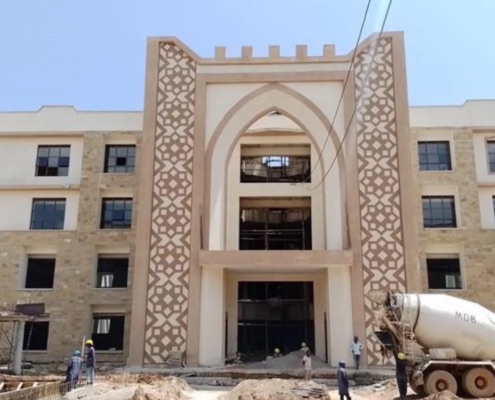
When the first students finally reported to Ronald Ngala Utalii College in Vipingo, Kilifi County, on September 1, 2026, the government had every reason to celebrate.
After years of promises, inspections, parliamentary inquiries and financial controversy, the Coast finally had a functioning public tourism and hospitality training institution.
But behind the photographs of students entering new classrooms lies a much darker public-finance story.
The college was conceived more than two decades ago. Construction eventually began in 2013. It was supposed to be substantially completed years ago.
Instead, the project became trapped in a cycle of redesigns, funding shortages, delayed payments, interest claims, parliamentary investigations and corruption allegations.
At the centre of the construction controversy was Mombasa-based Mulji Devraj & Brothers Limited, which won the principal works contract in 2013 at Sh8.961 billion.
The Auditor-General subsequently questioned why the contract went to the third-lowest prequalified bidder when the lowest bidder, China Jiangxi International K Ltd, had submitted a price about Sh498.7 million lower. The audit also questioned a contractual arrangement allowing 10 per cent advance payment and interest charges on delayed payments.
The contractor has never been convicted of corruption over the project.
But the public record raises a question that President William Ruto should not allow to disappear beneath the ribbon-cutting ceremony:
How did a college originally approved at roughly Sh1.94 billion become a project associated with costs running into more than Sh14 billion, while the Coast waited years for students to enter its gates?
The Sh1.9 billion project that exploded
The first warning sign was the price.
Parliamentary records show that Cabinet had approved the project at approximately Sh1.94 billion. The project was subsequently tendered at about Sh8.9 billion, a dramatic escalation that Parliament later scrutinised.
The Public Investments Committee examined the project and recorded that the main contract was awarded to Mulji Devraj & Brothers for Sh8,961,370,998.
The committee’s records also show that in August 2014 the contract was revised downward to Sh4.923 billion.
But even that rationalisation did not end the financial problem.
The project continued to consume money while its completion date repeatedly slipped.
By 2026, reports citing Tourism Fund financial information put certified project costs at more than Sh14.4 billion, with the Fund still carrying substantial unpaid bills linked to the college.
That figure is not the same thing as saying Mulji Devraj personally received Sh14.4 billion. It is the wider cost associated with the project and its accumulated liabilities.
That distinction matters.
The real scandal is how a public project could move from a Cabinet-approved Sh1.94 billion concept to a multibillion-shilling financial burden without producing the promised institution on schedule.
The contractor’s defence
Mulji Devraj has consistently disputed the suggestion that the delay was its fault.
When parliamentary investigators visited the project in August 2021, Mahendra Halai represented the contractor.
Halai told MPs that the company had been awarded the project in 2013 but received its first payment only in 2014.
“Payment has been a big issue,” he said, according to reporting from the parliamentary inquiry.
The contractor’s position was therefore straightforward: government failed to finance the project on time.
That defence is supported by other evidence.
The Tourism Fund itself has repeatedly attributed interest and penalties to delayed payments and insufficient releases from the Treasury.
In 2024, the Auditor-General reported that the Fund faced about Sh3.4 billion in interest penalties, including a claim of approximately Sh679 million from the contractor arising from delayed payment for works.
Consultants had accumulated another roughly Sh2.9 billion in penalties linked to delayed settlement of certificates.
This is where the Ronald Ngala story becomes more disturbing.
The State was not merely late in building a college.
It was creating a financial environment in which every delayed payment could produce another claim.
Parliament accused the contractor of deliberately delaying
The most explosive allegation did not come from social media or an anonymous source.
It came during a parliamentary inquiry.
In August 2021, MPs investigating the project accused the contractor of deliberately delaying construction to benefit from interest and penalties.
The parliamentary committee chair, Ole Kenta, was reported as telling the contractor that it could not delay a project for years while earning interest and penalties.
The contractor denied responsibility and maintained that government payment delays were responsible for the stalled works.
That exchange should remain central to any serious investigation into Ronald Ngala.
It does not prove that Mulji Devraj deliberately delayed the project.
But it establishes something important: the allegation was formally raised during parliamentary scrutiny, and the contractor had an opportunity to explain its position.
The company’s explanation was that it was waiting for government money.
The government, meanwhile, continued accumulating liabilities.
The Auditor-General’s Sh8.96 billion question
The Auditor-General’s concerns went beyond delays.
The 2016/17 audit report questioned the award itself.
Mulji Devraj was the third-lowest prequalified bidder, yet received the contract for Sh8,961,370,998.
The lowest bidder was China Jiangxi International K Ltd.
The price difference was Sh498,731,291.
The Auditor-General said it was unclear why the contract was not awarded to the lowest bidder, given that the firms had undergone evaluation and prequalification.
The audit also questioned the contract’s interest provisions and 10 per cent advance payment.
Those findings do not establish corruption.
But they establish that the country’s supreme public audit institution considered important aspects of the transaction insufficiently explained.
For a project ultimately financed by public resources and tourism levies, that should have triggered much more aggressive scrutiny.
Then came the interest machine
The most consequential part of the Ronald Ngala saga may not be the original tender.
It may be what happened after the tender.
Government funding arrived slowly.
Certified bills accumulated.
Contractors and consultants sought payment.
Interest and penalties accumulated.
The project remained incomplete.
Then additional money was required to finish it.
This cycle was visible to Parliament.
In 2023, the National Assembly Departmental Committee on Tourism and Wildlife ordered construction stopped pending its inquiry and demanded that Treasury provide a clear financing roadmap for the project and its outstanding bills, including penalties arising from delayed payment and inadequate funding.
Parliament said the project had originally been targeted for completion in 2018 at Sh4.9 billion but was then projected to consume as much as Sh11 billion.
By then, the college had become a textbook example of how delayed public financing can turn an ordinary construction contract into a long-running financial liability.
The corruption case that collapsed
The construction controversy eventually fed into a much larger corruption investigation.
In December 2023, former Tourism Cabinet Secretary Najib Balala, former Principal Secretary Leah Gwiyo and consultant Joseph Odero, among others, were charged over alleged irregularities surrounding the Ronald Ngala project.
EACC said its investigation established that Cabinet had approved a project costing about Sh1.95 billion but that the cost had subsequently risen to Sh10.4 billion.
The commission further alleged that about Sh8.5 billion had been irregularly paid and that about Sh4 billion went to Baseline Architects for consultancy services.
These were allegations by investigators, not findings of guilt.
The case collapsed before the evidence could be tested at trial.
On July 31, 2024, the Office of the Director of Public Prosecutions sought withdrawal of the case, saying investigations were incomplete.
Malindi Chief Magistrate James Mwaniki allowed the withdrawal.
EACC publicly protested, saying the decision undermined its investigations.
The collapse left one of Kenya’s most controversial public construction projects without a completed criminal trial determining whether the alleged irregularities actually occurred.
That is an accountability gap.
EACC said there was another file
There was an even more intriguing development.
In January 2024, EACC chief executive Twalib Mbarak said the Balala case represented only the first phase of the investigation.
According to Mbarak, the first case concerned the consultancy side of the project.
He said a second investigation was focused on the construction component.
That is potentially significant because the construction contract is precisely where Mulji Devraj & Brothers sits at the centre of the public record.
The public question is simple:
What became of that second file?
If it was completed, was it forwarded to prosecutors?
If it was not completed, why?
If investigators found no criminal basis against the contractor or officials, what were the reasons?
And if evidence remained outstanding, why has the public never been given a clear account of its status?
The Halai question
The contractor’s directors have also appeared in reporting around the wider Tourism Fund controversy.
Nilesh Halai, a director of Mulji Devraj, was identified in previous investigative reporting concerning the agency.
Other reporting alleged that Mahendra Halai was involved in efforts to influence the appointment of David Mwangi as Tourism Fund chief executive.
Those allegations were serious but have not been established by a court.
They should therefore remain allegations, not facts.
What is independently documented is that Parliament investigated the Tourism Fund and that Mulji Devraj’s contract was repeatedly scrutinised.
The Public Investments Committee record shows that management defended the tender award by saying Mulji Devraj had obtained the highest combined technical and financial score among six prequalified bidders.
The committee accepted that explanation and marked that particular issue resolved.
That finding is important because it provides the contractor’s side of the tender controversy.
An investigative account that ignores it would be incomplete.
A college caught between three presidencies
The political symbolism of Ronald Ngala is difficult to miss.
The project survived the presidencies of Mwai Kibaki, Uhuru Kenyatta and William Ruto.
A parliamentary debate in August 2023 captured the frustration.
MPs noted that the project had been running since the Kibaki era, had survived one president leaving office and another completing two terms, yet remained incomplete under a third administration.
The project was originally intended to strengthen tourism training at the Coast.
Instead, an entire generation of potential students watched the construction site remain unfinished.
In 2026, that finally changed.
The first students arrived.
Reports initially spoke of a planned intake of 1,000, although the actual opening was considerably smaller. The Eastleigh Voice reported 200 pioneer students, while The Star reported 114 students on the first day.
The contradiction itself illustrates how hurried the final phase was compared with the years spent getting there.
Ruto’s unfinished accountability job
President Ruto is expected to officially launch the institution.
He should do more than open it.
The opening gives State House an opportunity to order a final forensic accounting of one of Kenya’s longest-running public construction controversies.
The question should not simply be who finally completed Ronald Ngala Utalii College.
The question should be:
How much did Kenya ultimately pay, who received the money, under which contracts, for what work, and why did it take more than a decade after construction began for the institution to admit its first students?
The answer should include every major contract, variation, certificate, interest claim, penalty, consultancy payment, Treasury release and outstanding bill.
It should establish precisely what Mulji Devraj & Brothers was paid.
It should establish what remains payable.
It should identify the officials who authorised variations.
It should establish why the project moved from approximately Sh1.94 billion to Sh8.96 billion and eventually to costs reported above Sh14 billion.
And it should establish whether the billions in interest and penalties were an unavoidable consequence of government failure to pay on time, a consequence of contractual design, or partly the result of delays attributable to contractors or consultants.
Those are questions that cannot be answered by a ribbon-cutting ceremony.
The contractor is still in business
There is another reason the Ronald Ngala file should not simply be closed because the college is now operational.
Mulji Devraj & Brothers remains an active construction company.
On its own website, the company lists Ronald Ngala University in Vipingo among its projects and gives the project value as approximately Sh4.6 billion, while describing the work as ongoing.
The company also presents itself as a long-established construction firm with projects across Kenya.
That makes the Ronald Ngala questions more than historical curiosities.
They go to the heart of how the State manages major contractors, variations, delayed payments and public projects.
The real scandal is not that the college finally opened
Ronald Ngala Utalii College is no longer a white elephant.
Students are inside.
That is good news for Kilifi and for Kenya’s tourism industry.
But opening the doors does not erase the financial history.
The Auditor-General questioned the original tender.
Parliament investigated the cost escalation.
MPs accused the contractor of deliberate delay, an allegation the contractor rejected.
The contractor blamed delayed government payments.
The State accumulated billions in interest and penalties.
EACC investigated alleged corruption and charged senior former officials.
The DPP later withdrew the case before trial.
EACC said a second construction-related investigation existed.
And years later, the college finally opened.
The public is entitled to know what happened in between.
President Ruto’s administration now has an opportunity to turn Ronald Ngala from another Kenyan scandal buried under a new coat of paint into a full public-accountability case study.
The issue is not whether Mulji Devraj & Brothers is guilty of corruption. No court has established that.
The issue is whether Kenya’s public procurement and project-management system allowed a contractor, consultants and successive State officials to remain inside a multibillion-shilling project for years while the institution itself remained unfinished.
Twenty years after the dream was conceived, the students have finally arrived.
Now the country needs the full bill.
There's no story that cannot be told. We cover the stories that others don't want to be told, we bring you all the news you need. If you have tips, exposes or any story you need to be told bluntly and all queries write to us [email protected] also find us on Telegram
