
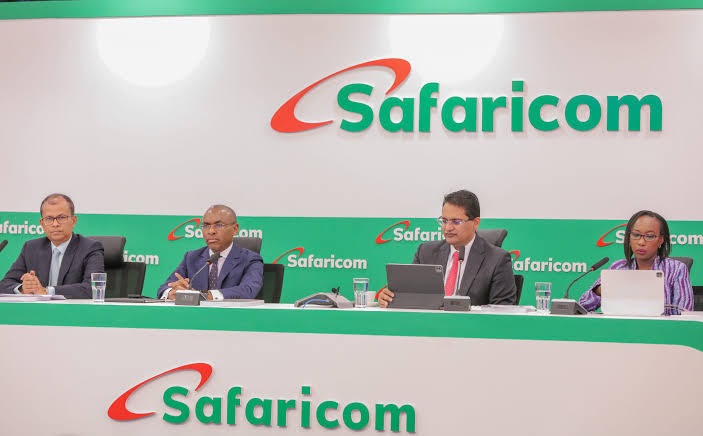
For years, Safaricom stood as the undisputed symbol of Kenyan corporate excellence.
It was the company that revolutionised mobile money through M-Pesa, rewarded shareholders generously, expanded digital connectivity and built one of Africa’s most admired brands. Under former chief executives Michael Joseph and the late Bob Collymore, Safaricom cultivated a reputation for innovation, transparency and public trust.
Today, however, a growing chorus of critics argues that the company’s image has suffered significant damage under the leadership of Chief Executive Officer Peter Ndegwa and Chairman Adil Khawaja.
The criticism is not primarily about profitability. On paper, Safaricom remains one of East Africa’s strongest companies, reporting record revenues, expanding into Ethiopia and continuing to dominate Kenya’s telecommunications and mobile money sectors.
Instead, the concerns centre on governance, public trust, political proximity, transparency and the handling of some of the most controversial episodes in the company’s recent history.
The debate has intensified following revelations contained in a Vodafone filing with the United States Securities and Exchange Commission indicating that, should Vodacom complete its acquisition of a controlling stake in Safaricom, foreign shareholders would gain greater influence over the appointment of future chief executives. The disclosure has reignited questions about how Safaricom arrived at this moment and whether confidence in its current leadership has been eroded. (Techpoint Africa (https://techpoint.africa/insight/techpoint-digest-1364/?utm_source=chatgpt.com))
Peter Ndegwa’s Contradictory Legacy
When Peter Ndegwa became Safaricom’s first Kenyan chief executive in April 2020, many viewed the appointment as a historic milestone.
After years of foreign leadership, the company was finally being handed to a Kenyan executive with extensive international experience at consumer goods giant Unilever.
His appointment generated enormous expectations.
Six years later, Ndegwa leaves behind a record that supporters describe as financially impressive but critics view as deeply controversial.
The defining challenge to his leadership emerged during the Gen Z-led anti-Finance Bill protests of June 2024, when Safaricom suffered a major internet disruption as demonstrations reached their peak.
The timing triggered widespread suspicion among sections of the public and civil society groups who questioned whether the outage was purely technical. Safaricom consistently maintained that the disruption resulted from reduced bandwidth and undersea cable problems, while Ndegwa publicly apologised to customers and denied any deliberate interference. (The Star (https://www.the-star.co.ke/counties/coast/2024-06-25-safaricom-explains-slow-internet-speed?utm_source=chatgpt.com))
Yet the controversy never fully disappeared.
Human rights organisations, digital rights advocates and sections of Kenya’s online community continued demanding greater transparency about the incident. For critics, the outage became a symbol of a widening trust gap between Safaricom and the public. (Kenya Human Rights Commission (KHRC) (https://khrc.or.ke/press-release/safaricom-must-immediately-cease-its-attacks-against-khrc-muhuri-daily-nation-and-journalists-and-answer-grave-allegations-against-it/?utm_source=chatgpt.com))
A second and potentially more damaging controversy emerged from allegations surrounding Safaricom’s handling of customer data.
Investigations published by Nation Media Group in 2024 alleged that security agencies had access to customer information in ways that could facilitate surveillance operations. Safaricom strongly denied wrongdoing and insisted it complies with Kenyan law and data protection requirements. The allegations nevertheless triggered interventions by rights organisations including the Kenya Human Rights Commission, Katiba Institute and MUHURI, all of which demanded greater accountability and transparency. (Kenya Human Rights Commission (KHRC) (https://khrc.or.ke/press-release/mck-complaints-commission-must-reject-safaricoms-baseless-complaint-against-the-nation-and-its-journalists/page/3/?utm_source=chatgpt.com))
The dispute escalated into a broader confrontation between Safaricom and sections of the media.
Civil society groups accused the company of responding aggressively to investigative reporting instead of fully addressing public concerns. Safaricom, on the other hand, argued that some reports contained inaccuracies and sought formal remedies through regulatory and legal channels. (Kenya Human Rights Commission (KHRC) (https://khrc.or.ke/press-release/mck-complaints-commission-must-reject-safaricoms-baseless-complaint-against-the-nation-and-its-journalists/page/3/?utm_source=chatgpt.com))
For many observers, the perception that Safaricom had become increasingly defensive under Ndegwa marked a sharp departure from the more open public posture associated with earlier leadership eras.
Adil Khawaja and the Politics Question
If Ndegwa became the face of operational controversies, Chairman Adil Khawaja increasingly found himself at the centre of governance and conflict-of-interest debates.
Khawaja entered Safaricom’s boardroom with impeccable credentials.
A respected corporate lawyer and managing partner at Dentons Hamilton Harrison & Mathews, he had previously served in senior leadership roles across major Kenyan institutions.
However, critics began questioning whether his close association with President William Ruto’s administration created uncomfortable optics for a company that occupies such a sensitive position in Kenya’s economy.
Those concerns intensified after Khawaja publicly acknowledged a decades-long friendship with President Ruto and defended his frequent participation in presidential investment missions abroad.
While Khawaja maintained that his involvement was professional and aimed at supporting investment promotion, critics argued that the relationship blurred the distinction between corporate leadership and political influence.
The questions became even louder because Safaricom is not an ordinary company.
It controls a dominant share of Kenya’s mobile communications market and oversees financial transactions worth trillions of shillings annually through M-Pesa.
Any perception that its leadership is too close to political power inevitably attracts scrutiny.
Additional criticism emerged from Khawaja’s role as managing partner of a law firm involved in representing corporate interests linked to some of the most politically contentious investment projects in Kenya.
Corporate governance experts and activists questioned whether these overlapping relationships created conflicts that required more robust disclosure and recusal mechanisms.
Although no regulatory authority has found wrongdoing against Khawaja, the perception problem has persisted.
For a company built on public trust, perception can be nearly as damaging as proven misconduct.
Customer Frustration Meets Corporate Success
Perhaps the most striking criticism facing Safaricom today is the growing disconnect between financial performance and customer sentiment.
The company continues to post strong results and remains one of the Nairobi Securities Exchange’s biggest success stories.
Yet social media platforms have increasingly become forums for complaints about service quality, customer care responsiveness, network performance and device-related issues.
Customers have raised concerns about internet reliability, data costs and experiences with Safaricom’s customer support systems.
While individual complaints do not necessarily reflect broader operational realities, the volume and persistence of such criticism have fuelled a narrative that Safaricom has become too dominant and too comfortable.
For critics, the issue is not profitability itself.
It is the perception that corporate success is increasingly being prioritised over customer experience.
That perception has become one of the biggest reputational challenges facing the company.
A Leadership Era Under Intense Scrutiny
Neither Peter Ndegwa nor Adil Khawaja can be blamed for every challenge facing a company with tens of millions of customers and enormous national significance.
Safaricom remains profitable, technologically influential and strategically important to Kenya’s economy.
Yet leadership is ultimately judged not only by financial performance but also by public trust.
That is where critics argue the Ndegwa-Khawaja era has struggled most.
Questions surrounding internet disruptions, customer data privacy, relations with the media, political proximity, governance transparency and customer dissatisfaction have combined to create one of the most turbulent periods in Safaricom’s modern history. (Kenya Human Rights Commission (KHRC) (https://khrc.or.ke/press-release/mck-complaints-commission-must-reject-safaricoms-baseless-complaint-against-the-nation-and-its-journalists/page/3/?utm_source=chatgpt.com))
As Vodacom moves closer to assuming majority control and discussions about Safaricom’s future leadership intensify, the legacy of Peter Ndegwa and Adil Khawaja is likely to remain fiercely debated.
Supporters will point to record profits, regional expansion and shareholder value.
Critics will point to trust deficits, governance controversies and a company that, in their view, grew increasingly distant from the public that made it successful.
The battle over which narrative ultimately defines their tenure has already begun.
There's no story that cannot be told. We cover the stories that others don't want to be told, we bring you all the news you need. If you have tips, exposes or any story you need to be told bluntly and all queries write to us [email protected] also find us on Telegram
