
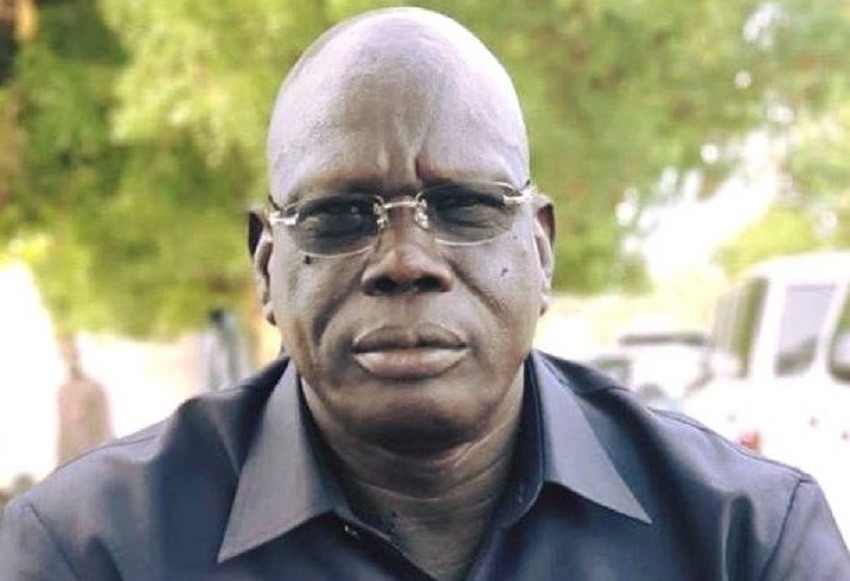
Juba / Nairobi / Washington — September 20, 2026
For seven years Kur Ajing Ater has lived as two men.
One is the Juba tycoon who pays stadium rent, slaughters bulls at the gate, and once fronted a $200,000 COVID mask donation through a company already blacklisted in Washington. The other is the man the U.S. Treasury put on the Global Magnitsky list in October 2019 for bribing South Sudanese officials, kicking back military food contracts, and moving oil money in cash so it never touched a bank.
Kenyan civil society activists now say there is a third face: a logistics man for Sudan’s Rapid Support Forces.
In a briefing circulating in Nairobi this week, unnamed human rights organisers accused Ajing’s post-sanctions vehicle, Amuk for Trading and Investment Co. Ltd, of feeding the RSF war machine with food, fuel, vehicles, drones, medicines and, they claim, arms since Sudan’s conflict erupted in April 2023. They say more than four cargoes of South Sudanese crude, valued at about $500 million, were allocated to Amuk and then steered toward accounts controlled by RSF commander Mohamed Hamdan “Hemedti” Dagalo and his younger brother, Algoney Hamdan Dagalo Musa, the paramilitary’s sanctioned procurement chief.
Those specific cargoes, bank traces and manifests have not been independently published. What has been published, for years, is how Ajing rebuilt a contracting empire after the United States tried to shut him down, and how that empire still runs on oil, family names and cash.
That is the story Washington never closed.
The 2019 hit that did not stick
On 11 October 2019, OFAC designated Ajing and Lou Trading and Investment Company Limited under Executive Order 13818. Treasury’s language was not vague. Ajing, it said, bribed key officials to keep a grip on the oil market; used those bribes to buy a senior gatekeeper and the silence of others; took a large 2018 government cash payment billed as food that instead went to a senior official; accepted oil allocations and handed back money and vehicles; routed oil payments in cash rather than through official accounts; and sat on a multi-year military food contract while kicking a percentage upstairs. Public reporting at the time noted that one of those military contracts dwarfed the army’s entire annual goods-and-services budget.
Ajing, born 2 January 1962, with a Juba address and South Sudanese passport B00001010, remains on the SDN list. U.S. persons still cannot deal with him. His U.S.-touchable property is still blocked. On paper, the designation worked.
In Juba, the contracts kept coming.
The three-week company
The Sentry’s October 2021 alert remains the most detailed map of the workaround. Amuk for Trading and Investment was incorporated in South Sudan about three weeks after Ajing’s designation. Its public face was Christine Achol Akot, identified by The Sentry as Ajing’s wife. The company’s listed phone number traced back to Ajing himself.
Within months the Ministry of Defence was writing Amuk the same kind of dollar food contracts Lou Trading used to get:
- $539.4 million in March 2020
- $644 million in September 2020, presented as a single-source “urgent need” award, the language governments use when they do not want a tender
Those two deals alone topped $1 billion. The Sentry flagged them as near-copies of the pre-sanctions Lou model and a breach of the spirit of South Sudan’s 2018 Public Procurement Act. It recommended OFAC look at Amuk and at Achol Akot. Treasury has not publicly designated either.
The method is older than this war: park the sanctioned name, stand up a relative, keep the same ministry, keep the same commodity, keep the dollars.
South Sudanese outlets later tied Ajing to partner Paulino Diing Madol, to Digitel Telecommunications, and to Dubai-facing vehicles including Silwana Diamond General Trading LLC. Documents reviewed by The Sentry described a July 2021 $650 million sovereign guarantee linked to a multi-year, oil-backed infrastructure partnership involving Silwana and an Amok/Amuk trading entity. Ajing appeared at a Dubai signing. Separate Juba reporting claimed oil cargoes already allocated to the Amuk orbit for army food supplies. Those claims were never tested in a courtroom. They were never walked back either.
Oil as currency, cash as camouflage
Ajing’s original OFAC file is a manual for how South Sudan’s elite convert crude into political loyalty.
Oil is not only exported. It is obligated: cargoes promised to favoured traders who then sell, net, and recycle a cut to the officials who signed the allocation. Treasury said Ajing had done exactly that, and that a senior official had asked him to take oil payments in cash rather than through official banks. Cash does not generate a SWIFT message. Cash does not trip a compliance filter in New York. Cash is how a Magnitsky listing becomes a lifestyle inconvenience instead of a prison.
That is why the new activist file, if it is ever produced, will live or die on paper: bills of lading, correspondent-bank trails, and the identity of the accounts that received the alleged $500 million. Until those documents appear, the allegation is this: the same oil-for-contracts machine Treasury described in 2019 is now pointed at a different army.
The named counterpart on the Sudan side is not anonymous. Algoney Hamdan Dagalo Musa was sanctioned by OFAC on 8 October 2024 as RSF procurement director. Treasury said he ran front companies, including UAE-based Tradive General Trading L.L.C., which imported vehicles later fitted as technicals, and that his work helped sustain the siege of El Fasher. Tradive had already been designated. In early 2026, U.S. identifiers for Algoney were updated to include a Kenyan passport, AK1586127, and a UAE identity number. Nairobi has denied issuing him a Kenyan passport. The Treasury listing still carries the number.
That is the junction the Nairobi activists are trying to force into view: South Sudanese oil paper, an Amuk trading name already used to outrun one set of U.S. sanctions, and a Dagalo procurement network that already lives in Dubai and, according to Washington’s own spreadsheet, on a Kenyan travel document.
The philanthropy screen
Ajing has not hidden. He has performed.
In June 2020, with Lou Trading still a designated entity, state television showed him pledging $200,000 for locally made face masks. In September 2025 he was on the phone to Juba sports reporters, insisting he had only paid the rent at Juba National Stadium for a Twic–Abyei match, plus two bulls and four artists, not a full sponsorship, not a $1,000-a-player bounty. He talked about brotherhood. He told pages not to spread “falsehoods.” A friendly opinion writer in 2020 called him a “renowned philanthropist” and dismissed corruption stories as jealousy.
This is patronage with a press officer. In a country where the state pays contractors in oil and the contractors pay the state in loyalty, public gifts do political work that compliance officers cannot freeze. They buy a crowd. They buy a headline. They buy the sentence that always follows the next exposé: but he helps the people.
The people of South Sudan still queue for food. The RSF war next door has killed on a scale aid agencies now put above 200,000 and displaced more than 14 million. Ajing’s defenders will say army rations and stadium bulls are not genocide logistics. The activists in Nairobi say the same balance sheet can feed two forces if the cargo destination is a line item nobody audits.
What tougher sanctions would actually have to hit
Ajing is already sanctioned. Lou Trading is already sanctioned. That is the uncomfortable fact inside the new campaign.
A second designation that names Amuk, Christine Achol Akot, the Dubai intermediaries, and any bank that still clears oil-prepay dollars for those entities would close the hole The Sentry pointed at in 2021. Designating family members is exactly the amendment The Sentry asked Washington to write into the Magnitsky and South Sudan executive orders. Five years later, the family company is still the operating system.
Kenya is now in the frame whether Nairobi likes the lighting or not. Activists say RSF figures have used the city as a political rear base. U.S. paperwork says Hemedti’s procurement brother holds a Kenyan passport number. Khartoum has accused President William Ruto’s government of partiality. State House calls that propaganda. Passports, hotel bookings and oil letters of credit are not propaganda. They are records.
Ajing has not issued a detailed public rebuttal to the RSF file. He has not had to. For seven years the method has been consistent: keep the oil allocation, change the letterhead, smile for the camera, and let Washington’s list age.
The list aged. The war did not.
Ajing and Amuk did not respond to requests for comment before publication. The governments of South Sudan and Kenya have not addressed the specific cargo and banking claims circulating in Nairobi. Allegations of direct RSF supply remain attributed to unnamed civil-society sources pending documentary release.
There's no story that cannot be told. We cover the stories that others don't want to be told, we bring you all the news you need. If you have tips, exposes or any story you need to be told bluntly and all queries write to us [email protected] also find us on Telegram
