

Dennis Ombachi did not write a policy paper. He closed the account. That is the part that should worry NCBA more than any press statement.
On 12 September 2026, the former Kenya Sevens Olympian and Roaming Chef posted that NCBA’s app “never works,” that he waited an hour on the phone for a human being, and that the bank had left him stranded in a supermarket queue. Then, before the official apology could finish loading, he posted again: he had already gone to the branch and shut the account.
The bank’s reply was the same script Kenyans have been reading for years. We’re truly sorry for the frustrating experience. Please share your account number via DM. Ombachi did not share. He left. The screenshots spread. Other customers piled on with the same refrain: the app dies at the till, the call centre is a holding pattern, and the relationship ends the day someone with a platform says it out loud.
That is not a celebrity tantrum. It is a public confirmation of a private habit.
Ombachi’s complaint was specific and humiliating: a payment app that fails when you need it, a helpline that makes you wait while the line behind you grows, and a bank that still markets itself as frictionless. Play Store and App Store reviews for NCBA NOW have said the same thing for years. Launch failures. Payment hangs. OTPs that arrive after the transaction is dead. Customer care that answers with “sorry for your experience.” Google Play still shows a high headline rating because volume hides the pattern. The one-star reviews describe the exact scene Ombachi put into words.
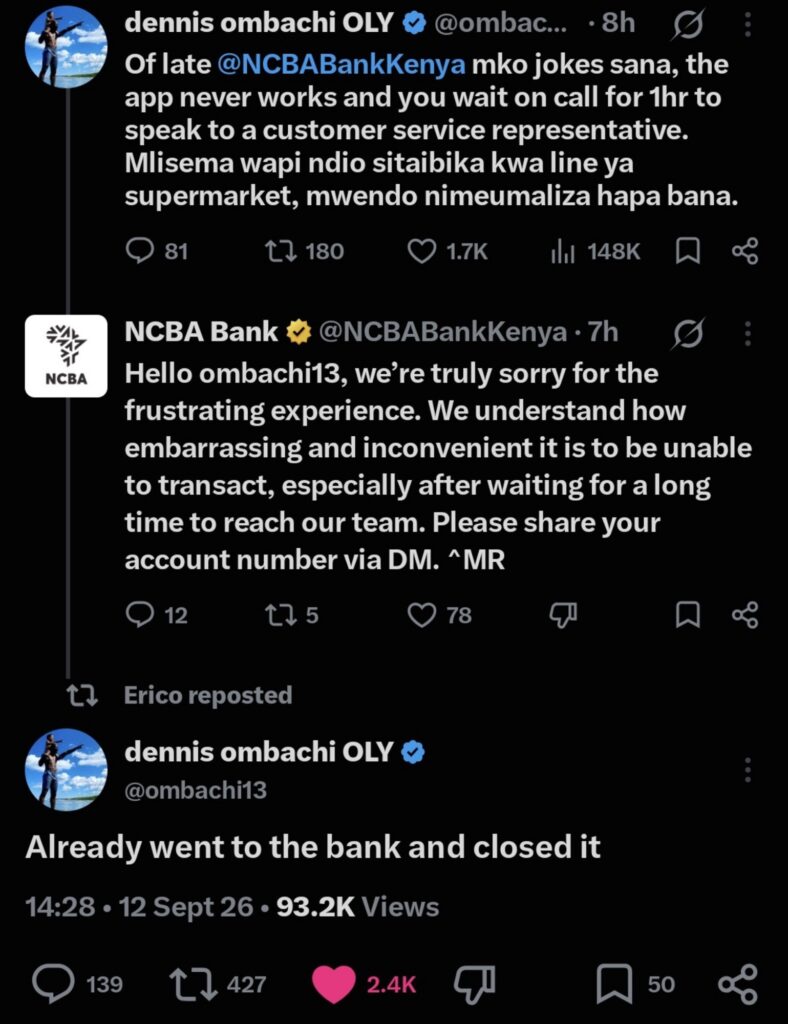
NCBA’s public-facing playbook is consistent. When the app or USSD fails, the official account apologises, asks for a DM, and points people to *488# or a complaints portal. That is not a fix. It is a deflection loop. Move the anger off the timeline, isolate the customer, close the ticket. Ombachi refused the loop.
Replies under his posts were not fawning. They were receipts. One user said they closed a brand-new account that had not lasted two months. Another called the bank “a nightmare.” A third said a Village Market relationship manager was so unreachable they abandoned the ATM card and walked. This is not a single bad weekend. It is a chorus that has been singing since the NIC–CBA merger created the NCBA brand and the service culture failed to catch up.
In September 2020, barely a year after NIC and Commercial Bank of Africa became NCBA, customers detonated on social media. A widely circulated thread accused the bank of CRB listings over trivial overdrafts, vanished transactions after system migrations, funds locked in accounts customers did not agree to, and a tone that treated ordinary holders as people who were “not rich enough” for decent service. The pattern in those posts, charges on dormant accounts, contradictory information from staff, post-merger chaos, is the same pattern still appearing in 2026 app reviews and X threads.
The Kenya Bankers Association’s 2025 customer survey captured the industry-wide contradiction. Satisfaction scores look fine until someone tries to resolve a complaint. Resolution within two days fell. Detractors rose. NCBA still ranked high on overall satisfaction in that survey. That is the dangerous number. A bank can poll well and still be the one that leaves a customer standing at a supermarket till. Ombachi is what happens when the poll and the queue collide.
If the story stopped at a glitchy app, this would be a service piece. It does not stop there.
In 2024 and 2025, prosecutors charged Philip Kiprono Rotich, assistant operations manager at NCBA’s Kisii branch and a ten-year employee, with 134 counts tied to the alleged diversion of about Sh52.4 million from customer accounts. Court papers name large victims, including a businessman said to have lost Sh14.7 million and a Catholic diocese and a bishop said to have lost about Sh9 million each. The alleged method was simple and devastating. Clients issued transfer instructions. The money was rerouted to associates. Some of it allegedly came back to the insider. Prosecutors told the court the alleged theft continued after the bank had already suspended him, meaning access was not cut when trust was. He pleaded not guilty. The case is a charge sheet, not a conviction. It is still a window into how the bank’s own systems treat the line between staff and customer money.
That case does not stand alone in the public record. Court reporting has described a 2023 matter involving Contact Centre and Credit Risk staff and the unauthorised reactivation of dormant accounts, with unauthorised debits put at more than Sh3.2 million. A separate 2025 case involved a software contractor on NCBA Rwanda’s mobile and retail platform, alleged to have altered the system so withdrawals cleared even on non-existent or underfunded accounts, with a claimed loss of about Sh57.5 million. In 2017-era predecessor-bank litigation later upheld in 2026, the Employment Court backed NCBA’s dismissal of an operations assistant after logs showed unauthorised after-hours viewing of customer profiles and contact with suspected fraudsters. Different years. Same theme: the people closest to the ledger.
Kenya’s Office of the Data Protection Commissioner fined NCBA Sh250,000 in November 2024 after finding the bank disclosed a UK-based solicitor’s personal data, name, phone, vehicle details, to third parties who were former employees, without a lawful basis. In April 2025 it sanctioned the bank again, another Sh250,000, after a business customer’s transaction emails kept going to the wrong address for years, even after both the customer and the unintended recipient told the bank to stop. Two separate findings. Same regulator. Same message: the bank cannot be trusted to keep a name and an email in the right box.
In August 2026, the DPP said the CEOs of NCBA, KCB and Co-operative Bank would be charged with failing to report suspicion regarding proceeds of crime, tied to the alleged theft of about Sh363 million from First Assurance Investment Ltd between 2018 and 2024 through accounts at the three banks. NCBA Group MD John Gachora is not accused of stealing the money. The allegation is institutional failure dressed as personal liability: that suspicious movement through the bank was not flagged as the law requires. The High Court quickly issued conservatory orders pausing the prosecution of the three chiefs while they challenge the charges. That pause is not an acquittal. It is a live fight over whether a bank CEO can be made criminally answerable when money allegedly walks through his house and nobody rings the bell. Kenya is still on the FATF grey list. This case is not a footnote.
NCBA is also locked in a London Court of International Arbitration fight with Multiple Hauliers shareholders over a 2017 financing. The bank wants roughly Sh12.7 billion back. The other side’s damages claim has been reported in the region of Sh88 billion, on the theory that incomplete disbursement helped wreck the company. Kenyan courts have already had to restrain enforcement steps so the arbitration is not gutted mid-flight. At the same time, reporting on NCBA’s own books has described deposit shrinkage after rate cuts, a loan book that lost its old lead over peers, and a Nedbank bid for a controlling stake that would turn a Kenyatta–Ndegwa era champion into a Johannesburg subsidiary. Founding families securing irrevocable commitments before the public vote is not illegal. It is a signal. The people who built the brand are pricing the exit.
Strip the slogans and NCBA’s public record shows a repeatable operating style. It sells convenience and delivers a queue: Mastercard partnerships, influencer-friendly cards, “Go for it” campaigns, then an app that fails at the till and a helpline that burns an hour. It apologises in public and contains in private. The official account is fast with “we’re sorry” and faster with “DM your account number.” The complaint leaves the street and enters a box the bank controls. Controls often work after the money has moved. Insider cases keep arriving with the same anatomy: privileged access, client instructions hijacked, dormant accounts woken up, contractors left holding production keys. Suspension without cutting access is not a control. It is a press release. Data is treated as an afterthought until a regulator invoices it. Two ODPC findings in six months is not a glitch. It is a process that does not treat personal data as a fiduciary asset. When the heat reaches the C-suite, the bank litigates the duty. The First Assurance matter is the clearest example. The institution handles the money. The argument becomes whether the law can touch the man whose name is on the letterhead.
None of that requires a conspiracy theory about dynasties. The political ownership story is already in the bloodstream of Kenyan public argument, Kenyatta-linked shareholding, old merger politics, tax-treatment grievances that activists never let die. Those claims should be proven in documents, not chanted. What does not need a chant is the paper trail already in courts, the ODPC, and the bank’s own timeline. Customers keep leaving for the same reasons Ombachi left.
Ombachi has built a brand on refusing the easy cheque when it collides with his stated values. He publicly cut Safaricom influencer work in 2024 over the Finance Bill protests and has said he turns down betting and alcohol money. Whether every stand is pure is a separate argument. The banking stand is simpler. He was a customer. The product failed in public. He closed the account instead of accepting a DM.
Banks survive angry tweets. They do not survive a reputation that the app dies when you are holding groceries, that staff can touch ledgers they should not touch, that emails of your business walk to a stranger, and that the official response is always a softer version of please take this offline.
NCBA can keep hosting fraud-awareness webinars while its own files fill with insider charges. It can keep posting PIN-safety graphics while a celebrity chef tells the country the call centre made him a spectacle at the till. It can keep saying “CBK regulated” in the bio. Regulation is not the same as reliability.
The uncomfortable fact is not that Dennis Ombachi closed an account. It is that thousands of quieter customers have been describing the same bank for six years, and it took a man with a balcony kitchen and hundreds of thousands of followers to make the institution answer in public, with the same apology it always uses, one hour too late.
There's no story that cannot be told. We cover the stories that others don't want to be told, we bring you all the news you need. If you have tips, exposes or any story you need to be told bluntly and all queries write to us [email protected] also find us on Telegram
