
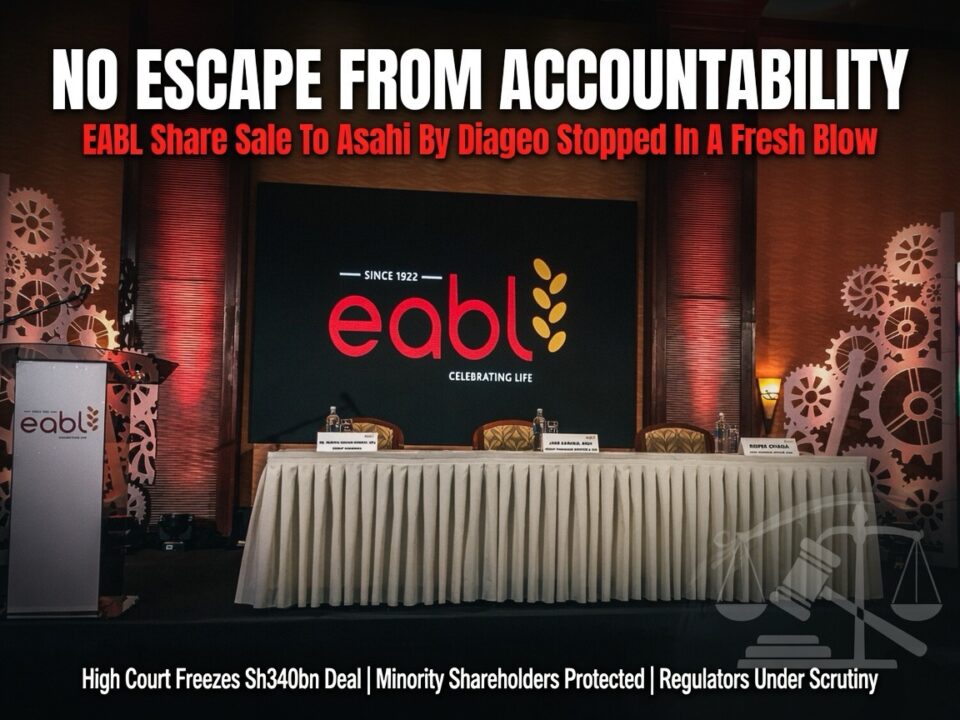
In a decisive courtroom intervention this week the High Court has frozen Diageo’s ambitious Sh340 billion plan to offload its 65 percent controlling stake in East African Breweries Limited and its 53.68 percent holding in spirits maker UDV Kenya to Japan’s Asahi Group Holdings. The order preserves the status quo on ownership, control and shareholding until at least July 2 2026 when the matter returns for mention.
Justice Josephine Mongare issued conservatory orders restraining Diageo Kenya Limited, Diageo Plc, EABL, Asahi and the regulators from completing, implementing or registering the transfer. This is the third concerted legal effort to block the deal and the one that has finally stuck.
The petitioner, businesswoman and public-spirited Kenyan Christine Irungu, has placed the entire transaction under a harsh constitutional spotlight. She argues that Diageo and EABL, with the apparent acquiescence of the Capital Markets Authority and the Competition Authority of Kenya, engineered a process that allowed the majority shareholder to consolidate control through a 2022 to 2023 tender offer while allegedly concealing its true intention to flip the enlarged stake to a foreign buyer at a substantial premium.
Between October 2022 and March 2023 Diageo Kenya launched a partial tender offer that raised its stake in the iconic listed brewer from 50.03 percent to 65 percent at KSh 192 per share. The move was presented to minority shareholders, the Nairobi Securities Exchange, the CMA and the investing public as a demonstration of long-term commitment to EABL and confidence in East Africa’s growth story.
Irungu’s petition contends there is now clear and incontrovertible evidence that talks to sell those very shares or the control they conferred were already underway or contemplated. If true, shareholders who sold into the tender were deprived of material information needed to assess the real value of their holdings. Those who stayed now face the prospect of a foreign-controlled entity capturing a control premium that was never offered to them.
The petition does not mince words. It states that the structure allegedly allowed Diageo to accrue an impermissible advantage and amounted to the taking of property of the 15 percent shareholders who were duped into selling their shares. It offends, Irungu argues, the fundamental equitable principle that a dominant shareholder cannot use its position, superior information and control of corporate processes to secure a private benefit at the expense of minorities.
The suit names CMA and CAK as respondents and accuses them of failing in their constitutional and statutory duties. CMA, the petition claims, did not adequately protect investors from the creation of a control premium or ensure full disclosure of the transaction’s true commercial purpose. CAK allegedly failed to properly weigh competition, consumer, distributor and wider public-interest implications.
Both regulators, Irungu says, violated Article 10 of the Constitution on national values of rule of law, good governance, transparency, accountability and public interest, Article 35 on access to information and Article 46 on consumer protection. The result is that minority shareholders and the broader investing public were left in the dark while a transformative foreign takeover of one of Kenya’s most significant listed companies was being quietly prepared.
The Law Society of Kenya has been joined as an interested party, underscoring the broader rule-of-law and capital-markets integrity questions at stake.
Earlier attempts by Nairobi beer distributor Bia Tosha and contractor JILK Construction to halt the transaction were thrown out. Judges found insufficient connection between those petitioners’ historical commercial disputes with EABL and the proposed stake transfer.
Irungu’s case is different. It goes straight to the heart of the share-acquisition process itself, the disclosures or lack thereof, the representations made to the market and the regulators’ oversight. That is why the court found enough merit to grant interim relief that has derailed the carefully laid timetable for a July to December 2026 closing.
The deal, announced by Diageo on 17 December 2025, would have delivered the British multinational an estimated 2.3 billion US dollars in net proceeds and handed Asahi control of Diageo Kenya Limited, the vehicle holding the EABL stake, plus the UDV Kenya interest. The National Treasury stood to collect around Sh42 billion in capital gains tax. That windfall, like the transaction itself, is now on ice.
What the court has done is simple but powerful. It has refused to let powerful corporate interests and pliant regulators steamroll through a transaction while serious, triable questions about disclosure, minority rights and market integrity remain unanswered.
Diageo, EABL and Asahi must now justify in open court why minority shareholders were not told the full story behind the stake increase. CMA and CAK must explain how they satisfied themselves that the process was fair, transparent and consistent with their mandates when new facts suggest the tender offer may have been the penultimate step in a pre-planned exit.
The petition seeks declarations that a controlling shareholder in a listed public company cannot lawfully exploit its dominant position and superior information to obtain a special private premium at the expense of minorities. It demands full disclosure of all sale agreements, term sheets, board papers, valuations, correspondence and regulatory filings. And it wants CMA and CAK compelled to conduct and publish fresh regulatory reviews.
These are not minor procedural gripes. They go to the credibility of Kenya’s capital markets, the protection of ordinary investors and the ability of regulators to stand up to multinational corporate maneuvering.
The corporations that hoped to conclude this deal quietly have been forced into the light. The unanswered questions about timing, disclosure, regulatory diligence and the equitable treatment of minority shareholders have become impossible to ignore.
Justice Mongare’s order is clear. The status quo on EABL’s ownership and control will be preserved. The big players will have to answer for their actions before any transfer proceeds.
There is no escape from accountability when the courts insist on answers. And for now at least the deal that was meant to quietly change hands at the top has been stopped in its tracks by one determined petitioner who refused to look the other way.
The matter returns to court on July 2. The uncomfortable questions will remain.
There's no story that cannot be told. We cover the stories that others don't want to be told, we bring you all the news you need. If you have tips, exposes or any story you need to be told bluntly and all queries write to us [email protected] also find us on Telegram
