
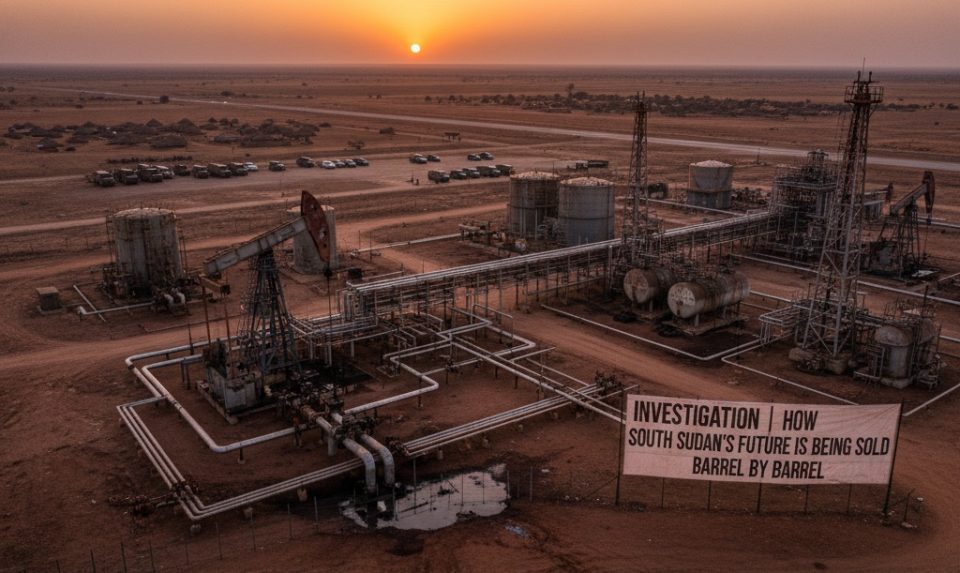
JUBA – South Sudan’s future is being quietly mortgaged through its most strategic national asset: crude oil. Leaked internal finance and petroleum documents, shipping records, and cargo allocation data obtained and reviewed by Sudans Post show that a shadow network of foreign trading firms, hidden intermediaries, and politically connected facilitators has captured the bulk of South Sudan’s oil exports, diverting revenues away from the state at a time when civil servants go unpaid, the currency is weakening, and the national economy is in visible distress.
At the center of this system sit two increasingly dominant but largely opaque firms: Cathay Petroleum and Euroamerica Energy. Together, they now control the majority of South Sudan’s crude flows through a structure that bypasses normal financial oversight, audit mechanisms, and prepayment safeguards that should protect public revenue.
This investigation traces how a high-risk oil trading continuum linking Arcadia Petroleum, Glencore, and Cathay Petroleum converged with Euroamerica Energy to quietly take control of South Sudan’s oil lifeline. That control became fully visible on 27 October 2025, when the Ministry of Petroleum of South Sudan formally requested an advance payment of one billion United States dollars against future crude oil entitlements.
![South Sudan finance ministry letter requesting $1M against future crude oil shipments. [Document obtained by Sudans Post]](https://i0.wp.com/www.sudanspost.com/wp-content/uploads/2025/11/dru-21008-U.jpg?ssl=1)
What the billion-dollar financing letter did not disclose is that it was not an isolated emergency move. On October 31, 2025, the Ministry of Petroleum issued a separate request for an advance payment of USD 1.5 billion to the China National Petroleum Corporation (CNPC), explicitly against crude oil entitlements linked to the Greater Nile Petroleum Operating Company (GNPOC).
This followed the earlier USD 1 billion advance payment request to ONGC Videsh, confirming that the government had begun approaching individual GNPOC shareholders separately for billion-dollar emergency financing against future oil production.
![A letter dated Oct. 31, 2025, from South Sudan’s Ministry of Petroleum requesting an advance payment of $1.5 billion from the China National Petroleum Corporation (CNPC) against future crude oil entitlements under the Greater Nile Petroleum Operating Company (GNPOC). The document is signed by Undersecretary Eng. Deng Luai Wol. [Letter obtained by Sudans Post]](https://i0.wp.com/www.sudanspost.com/wp-content/uploads/2025/12/WhatsApp-Image-2025-12-03-at-9.28.28-AM.jpeg?ssl=1)
According to the official ownership structure issued by South Sudan’s Ministry of Petroleum, GNPOC is jointly owned by CNPC at 40 percent, Petronas at 30 percent, ONGC at 25 percent, and Nilepet at 5 percent. This means the two documented advance requests — USD 1.5 billion to CNPC and USD 1 billion to ONGC — together target 65 percent of GNPOC’s total production capacity, effectively mortgaging the majority of South Sudan’s core oil output through bilateral debt arrangements.
Taken together, the USD 1 billion sovereign-level request (the USD 1 billion ONGC request), and the USD 1.5 billion CNPC request reveal a decisive shift in South Sudan’s oil governance: future crude is no longer being pledged as a single national asset, but as fragmented shareholder-linked debt instruments. Each advance locks in future barrels under separate repayment schedules, pricing formulas, and cargo controls — pushing national revenue further into opaque, off-book financial channels.
The requests, signed by Undersecretary Eng. Deng Luai Wol and addressed to foreign oil partners, confirmed what many inside government had long feared: South Sudan has begun selling tomorrow’s oil to survive today. The repayment structure was stretched over fifty-four months using both Dar Blend and Nile Blend crude, yet the letter remained silent on who truly controls the cargoes being pledged in this billion-dollar distress signal.
That answer lies offshore.
![Leaked cargo tracking and shipment allocation records showing South Sudan crude cargoes moving from Bashayer terminal to Asia and the Gulf through intermediaries including Cathay Marine, Epdesa and BGN. [Data obtained by Sudans Post]](https://i0.wp.com/www.sudanspost.com/wp-content/uploads/2025/12/MBT_vddcc-1.jpeg?ssl=1)
Cathay Petroleum, founded in March 2003 by a Chinese national operating between Hong Kong and Singapore, remained largely invisible in South Sudan’s oil trade for more than fifteen years. That changed abruptly in 2025. Leaked allocation records now show that a significant share of South Sudanese crude cargoes has been redirected to Cathay, transforming the firm into one of the most dominant offtakers in the country’s export system.
Its rise mirrors the historical patterns of high-risk commodity trading networks associated with sanctioned states, shell companies, and opaque financing structures. Long before its expansion in South Sudan, Cathay had traded crude linked to Libya, Yemen, North Sudan, and other politically sensitive markets.
Cathay’s deeper roots trace back to Arcadia Petroleum, a London-based trading group that operated heavily in South Sudan, Nigeria, and Yemen in the early 2010s. In 2018, Arcadia opened an internal fraud case involving three hundred forty-nine million dollars, alleging that former directors had used shell companies, including Cathay Petroleum, to execute suspect trades.
The case was eventually dismissed for lack of evidence, but the personnel pipeline survived. Several core Arcadia traders later moved to Glencore, and from Glencore a number of those same traders later resurfaced inside Cathay Petroleum. During this entire transition, Cathay did not emerge as a new commercial player but rather as a revived operational sleeve of the same networks that had previously operated through Arcadia and Glencore.
Glencore itself later publicly admitted paying bribes in South Sudan before ending its operations in the country. That admission now casts fresh shadow over the continuity of personnel and trading methods reappearing inside Cathay’s recent expansion.
While Cathay provides the trading platform, the physical and commercial seizure of cargoes is executed by Euroamerica Energy under the direction of Idris Taha, a Sudanese trader holding British nationality and frequently traveling on a German passport. Taha’s career spans nearly three decades of operating inside embargoed and grey-zone oil markets, beginning in Libya in the 1990s under sanctions through the oil-for-medicine system, shifting to Iran after 2011 through UAE connections, and later relocating his base of operations to Turkey and the United Kingdom after being branded persona non grata in the Emirates.
Today, Euroamerica Energy controls more than eighty percent of South Sudan’s crude cargoes in recent months. In November, two out of three cargoes moved through its network. In December 2024, three out of four followed the same route. Most critically, these cargoes are shipped without prepayments.
This creates complete opacity for the Ministry of Finance and Planning and the Bank of South Sudan, depriving the state of advance revenue visibility and leaving public finances exposed to sudden liquidity collapse. This opacity is now directly linked to the recent arrest of the Central Bank’s governor, a development whose oil-revenue implications remain officially unexplained.
Leaked finance ministry notes outlined a dual predatory scheme operating inside South Sudan’s upstream oil system. The first layer involves the direct diversion of crude cargoes through hidden intermediaries, while the second layer relies on the manipulation of prices and artificial inflation of upstream production costs. Under South Sudan’s cost-oil mechanism, producers are reimbursed for production expenses before profits reach the state. However, the system lacks real verification, enforceable ceilings, and independent audits. This allows a well costing twenty million dollars to be billed at one hundred million dollars, with the State legally obligated to absorb the loss.
Oil service firms linked to former Vice President Benjamin Bol Mel, to Cornelis Nicolaas Abraham Loos, and to Idris Taha are alleged to have charged up to three times standard international rates. These inflated figures are fully reimbursed under cost-oil rules, transferring the financial burden directly onto public revenue.
South Sudan’s oil commercialization is no longer a direct path from producer to refiner. Instead, leaked shipping and trade records reveal that a deliberately layered cascade of unnecessary intermediaries now sits between the oil fields and the final buyer. Crude now passes through first-level intermediaries before being resold to a second level of traders, and only then reaches the final buyer. At each layer, revenue is diluted, traceability is weakened, and beneficial ownership becomes harder to identify. Large portions of proceeds now disappear outside the formal banking system altogether.
![Leaked shipment records detailing South Sudan crude oil exports from Bashayer terminal to Asia and the Gulf, showing cargo sizes, end buyers and intermediary firms, including Cathay Marine, Epdesa and BGN. [Data obtained by Sudans Post]](https://i0.wp.com/www.sudanspost.com/wp-content/uploads/2025/12/scr-2112-scaled.jpeg?ssl=1)
Global end-buyers, including major international refiners and distributors, appear on paper to purchase commercially “cleaned” oil. Yet the investigation raises a stark compliance dilemma. Either these buyers knowingly tolerate opaque intermediaries whose ownership and compliance status they choose not to verify, or they fail at even the most basic due-diligence obligations. In both scenarios, responsibility attaches.
At its core, the system converges around cargo capture by Euroamerica Energy, trading through Cathay Petroleum, overbilling through the cost-oil framework, and political facilitation through former oil-sector power centers. This ecosystem has drained hundreds of millions of dollars from public revenue, weakened the national treasury, contributed directly to salary collapses, and forced the government into selling future oil through emergency borrowing.
South Sudan’s oil should have funded schools, hospitals, public salaries, and post-war reconstruction. Instead, those same barrels are now being pledged forward to cover present fiscal collapse under trading terms that benefit offshore intermediaries far more than citizens. Each cargo sold through these opaque chains is not merely a commercial transaction. It is a withdrawal from future generations, a transfer of national sovereignty into private networks, and a restructuring of the state’s economic destiny outside public consent. South Sudan is no longer simply exporting crude. It is exporting tomorrow.
When the state sells oil but cannot pay its workers
![Protest scenes at the ministry of finance as war herrors demands months of arrears in salaries. [Photo by Sudans Post]](https://i0.wp.com/www.sudanspost.com/wp-content/uploads/2024/02/WhatsApp-Image-2024-02-15-at-10.04.55-AM.jpeg?ssl=1)
The capture of South Sudan’s oil revenues by opaque trading networks is no longer an abstract financial crime. Its consequences are now visible in government offices, military barracks, schools, and hospitals across the country, where civil servants and organized forces go unpaid for months at a time despite the continuous export of crude from national oil fields.
Multiple government officials interviewed by Sudans Post said the contradiction is now impossible to ignore. While cargoes of Dar Blend and Nile Blend continue to move through offshore intermediaries under Euroamerica Energy and Cathay Petroleum, the treasury remains structurally starved of cash. Salary budgets may exist on paper, they said, but the money itself rarely materializes at the moment it is needed.
A senior official inside the public finance system, speaking on condition of anonymity, said funds allocated for salaries are routinely overtaken by emergency political and security spending before they ever reach workers. He said that during periods of military escalation, peace negotiations, or politically sensitive accommodations, salaries are treated as expendable liabilities rather than fixed obligations. The result is a cycle in which civil servants are technically “paid” through accounting entries while remaining functionally unpaid in real life.
“Money intended for salaries may be diverted or mismanaged. A large portion of the budget reportedly goes to military expenditures, political elites, and administrative costs, reducing the amount remaining for civil servants. Financial leakages, diversion of funds, and weak oversight reduce the money available for salaries. Even when the budget allocates funds, they may not reach employees on time,” the official told Sudans Post on November 10, 2025.
That contradiction became institutionalized in early 2025 when the former Vice President for the Economic Cluster, Benjamin Bol Mel, ordered that all civil servant salaries be paid on the 24th of each month. The directive was presented as a public confidence measure, meant to signal fiscal discipline and reform. The Ministry of Finance and Planning later confirmed that payments had been processed each month.
On the ground, however, the directive translated into paper compliance without liquidity. A finance officer with the South Sudan People’s Defence Forces, who is part of the team that processes payments for fallen soldiers, said that cheques are now routinely issued with no cash behind them. He said he personally holds multiple government cheques that cannot be redeemed because banks have no physical currency available.
He said the Ministry of Finance continues to transfer figures into institutional accounts, including the Ministry of Defence, but when recipients attempt to withdraw their salaries, they are told that the vaults are empty. Some of his colleagues, he said, have carried unpaid cheques for four to five months. On paper, the state has paid them. In reality, they have received nothing.
“Most of my colleagues have been carrying cheques for almost four to five months, and there is no money in the bank. Since the former Vice President and chairperson of the Economic Cluster ordered payment for the 24th of each month, we have been receiving cheques but no money in the bank.”
He said salaries were paid for March, April, May and June (2025) but staff were later issued cheques for July, August, September and October that banks were unable to honour due to cash shortages. As a result, workers have not received payments from July to November 2025, as well as for January and February 2025, in addition to salary arrears stretching back dozens of months from previous years.
For ordinary soldiers, the consequences have been devastating. A soldier who identified himself as Mabior said the salary delays have pushed many into food insecurity. He said some soldiers wait four to five months before receiving a single month’s pay, while others receive partial payments that do not cover even basic household needs. With market prices at historic highs, he said feeding families and paying school fees has become nearly impossible. He said they hear constant announcements of financial reforms, changes at the central bank, and new revenue measures, but nothing ever reaches their pockets.
“Most of us as soldiers take about four to five months to get paid; sometimes you receive only one month’s salary, and we need improvement in terms of timely payment of salaries. There are always changes in finance, the central bank, and revenue, but no good results are seen by the public. We hope that the government will do its best to improve payments for public sector employees, the army, and other organized forces.”
The crisis has spilled directly into the education system. The Minister of General Education and Instruction in Central Equatoria State, Cirisio Zakaria Lado, confirmed to Sudans Post in an interview that delayed salaries are crippling schools. He said many teachers no longer show up consistently because they spend days moving between banks searching for cash that is no longer there. Some, he said, take two full days to withdraw the equivalent of only thirty to forty thousand South Sudanese pounds after transport costs are deducted.
He said the problem is compounded by documentation barriers, with many teachers lacking the identity cards now required by banks to access funds. As a result, he said, the majority of teachers remain locked out of their own salaries even when payments are technically processed. The impact, he warned, is already visible in declining classroom attendance, shortened school hours, and rising dropout rates.
“We urge the government to ease the payment of salaries for teachers and other support staff. Some workers do not have the required identity cards to access their money in the bank; 90 percent cannot access their funds. We need to ensure that teachers are comfortable, and we want the issue of salaries to be resolved,” he stated.
The liquidity collapse at the heart of the salary crisis was publicly acknowledged in June by the former Minister of Finance and Planning, Marial Dongrin Ater. He said at the time that the shortage of South Sudanese pounds had crippled the economy and left the government unable to function normally. He admitted that salaries had been deposited into accounts for months without the physical cash necessary for people to withdraw them. Getting cash, he said, had become the single biggest problem facing the state.
“We have the major challenge that you will face: how to address the cash shortage in the economy. We have been able to pay salaries for the past seven months without fail, but that money goes into the account without cash. So, getting cash is the biggest problem,” the then finance minister said.
Another government employee, who identified himself as Moses, said the monthly salary circulars issued by the Ministry of Finance have become instruments of public deception rather than payment guarantees.
He said he has been paid only four times this entire year, despite seeing official circulars announcing payments every month. He alleged that these announcements are designed to calm public anger rather than reflect actual cash availability.
Human rights activist Ter Manyang Gatwech said the salary collapse reflects a deeper failure of budget prioritization. He said the state appears to have lost control of its most basic obligations while oil continues to flow offshore through opaque commercial structures. He questioned whether the crisis is the result of weak political direction, technical planning failure inside the finance institutions, or the direct outcome of revenue capture in the oil sector. In his view, the answer may be all three at once.
“This raises an important question: Are these delays the result of weak leadership direction, or do they reflect inadequate technical planning and coordination within the Ministry of Finance?” Manyang asked.
This is the point at which South Sudan’s oil scandal ceases to be merely about trading networks and becomes a direct threat to state survival. The same barrels of crude that are being pledged forward through billion-dollar advance schemes and diverted through hidden intermediaries are the very revenues that should be paying teachers, soldiers, doctors, and civil servants today.
Instead, the workers who hold the state together are being told to survive on cheques with no cash, promises with no purchasing power, and reforms with no visible results. Oil continues to leave the country. Salaries do not reach the people. The future is not only being sold barrel by barrel. The present is collapsing paycheck by paycheck.
There's no story that cannot be told. We cover the stories that others don't want to be told, we bring you all the news you need. If you have tips, exposes or any story you need to be told bluntly and all queries write to us [email protected] also find us on Telegram
