
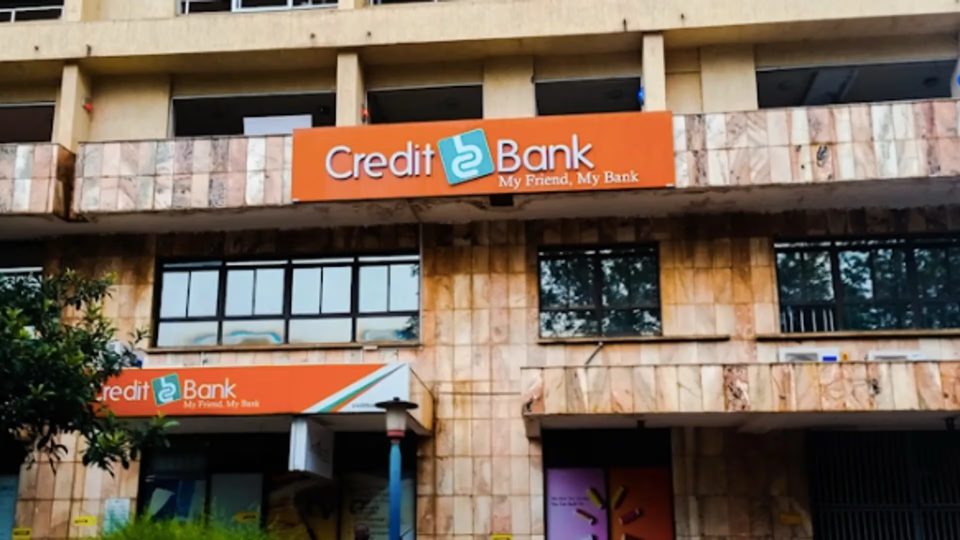
When the auctioneer’s hammer fell on June 5, 2024, a property worth billions changed hands in Mavoko. But in a transaction that has since exploded into a legal crisis, the buyer was Credit Bank itself, the same lender that had put the property up for auction after its borrower defaulted.
The Court of Appeal has now frozen the controversial deal, raising uncomfortable questions about whether banks can legally buy properties they seize from their own customers. The case threatens to send shockwaves through Kenya’s banking sector, where lenders regularly auction collateral from defaulting borrowers.
At the heart of the scandal is a prime parcel of land in Mavoko Municipality, registered as LR 12876/13 (IR 36277), which Credit Bank sold to itself for Sh1.125 billion. The borrower, Erdemann Property Ltd, claims the true market value is Sh2 billion, an undervaluation that if proven would represent a nearly Sh900 million loss.
The property had been charged to Credit Bank to secure financing that ballooned to Sh817.8 million after the developer defaulted. What should have been a straightforward debt recovery has instead become a cautionary tale about conflicts of interest, transparency failures, and the power imbalance between banks and borrowers.
Court documents reveal that Credit Bank made several failed attempts to auction the property before finally proceeding with the June 2024 sale to itself. The bank claims it was forced to buy the property because Erdemann sabotaged the auction by running caveat emptor advertisements in newspapers, warning prospective bidders of alleged impropriety.
But the Court of Appeal was not convinced. In a withering assessment, the judges noted glaring information gaps in Credit Bank’s case. The bank’s affidavit failed to answer fundamental questions. Were there other bidders at the auction? What was the highest bid? How exactly was the sale conducted?
These are not minor administrative oversights. Section 100(3) of the Land Act allows banks to purchase properties they auction, but only under strict conditions. The bank must either obtain court permission proving the self-purchase is most advantageous for the borrower, or if buying at public auction, must bid the highest price or meet the reserve price. The burden of proof lies entirely with the bank.
The judges diplomatically described the missing information as creating “an arguable issue” surrounding compliance with the Land Act. In legal terms, this was damning. Credit Bank had not demonstrated it followed the law.
The property was knocked down at Sh1.125 billion, the forced-sale value from a December 2023 valuation commissioned by Credit Bank itself. Erdemann disputes this valuation violently, insisting the open-market value is Sh2 billion. While undervaluation claims are common in Kenyan auction disputes, what makes this case explosive is Credit Bank’s dual role as both seller and buyer.
If the property was genuinely worth Sh1.125 billion or more, serious investors would not have been scared away by newspaper advertisements from a desperate borrower. The absence of competing bids suggests either the valuation was inflated or something more troubling was happening behind the scenes.
Credit Bank is leaning heavily on Section 99(4) of the Land Act, which provides that damages are the remedy for unauthorized, improper or irregular sales. In other words, even if the bank acted unlawfully, Erdemann’s only recourse would be monetary compensation, not unwinding the transaction.
But Erdemann has delivered a devastating counter-punch. The developer pointed to Credit Bank’s Sh32.4 million net profit in 2023, arguing that a potential Sh2 billion damages award would be catastrophic for the lender. If the bank cannot pay, then damages become a meaningless remedy and allowing the transaction to stand would be a miscarriage of justice.
The Court of Appeal clearly found this argument compelling. The bench issued a sweeping freeze order, blocking any onward sale, transfer or disposal of the property until the dispute is fully resolved. This is not the action of a court confident in a transaction’s legality.
The case raises uncomfortable questions that extend far beyond one bank and one borrower. Should banks be allowed to purchase properties they auction from customers? The practice creates an obvious conflict of interest. The bank has every incentive to acquire the property cheaply, maximizing loan recovery while minimizing what the borrower receives.
Some jurisdictions prohibit or severely restrict self-purchases by secured creditors for precisely this reason. Kenya allows them under the Land Act, but only with safeguards. This case will test whether those safeguards work.
Section 97(1) of the Land Act imposes a duty of care on banks exercising the power of sale. They must act in the best interests of the borrower, obtain fair value and conduct sales transparently. When a bank purchases property from its own customer, these duties become critical because the conflict of interest is glaring.
If the Court of Appeal ultimately rules that Credit Bank’s self-purchase was unlawful, banks across Kenya will face heightened scrutiny when attempting to buy properties they auction. Valuations will need to be beyond reproach. Auction processes will need to be meticulously documented. And banks may think twice before stepping in as buyers when independent bidders stay away.
Credit Bank portrays Erdemann as a desperate defaulter trying to delay the inevitable through litigation and public relations campaigns. The bank argues that Erdemann’s caveat emptor advertisements were a deliberate sabotage tactic designed to prevent legitimate sales and extend the company’s occupation of the property.
There is undoubtedly truth to this. Erdemann defaulted on its loan. The property was legitimately charged to Credit Bank as security. The bank had a right to enforce that security. Borrowers in distress often resort to scorched-earth litigation tactics.
But Erdemann’s desperation does not excuse procedural irregularities. The law protects even defaulting borrowers from improper exercises of the power of sale. If Credit Bank cut corners, failed to obtain fair value or purchased the property in violation of the Land Act, those violations do not disappear simply because Erdemann owed money.
The matter now returns to the Court of Appeal for a full hearing. Erdemann must prove the sale was unlawful, conducted at an undervalue or otherwise violated the Land Act. Credit Bank must demonstrate it complied with all statutory requirements, that the auction was fair and transparent and that its purchase was lawful.
The burden of proof on the self-purchase issue lies with Credit Bank. The bank must show it was entitled to buy the property under Section 100(3), either because it obtained court permission proving this was most advantageous for Erdemann, or because it bid the highest price at a properly conducted public auction.
Based on the Court of Appeal’s preliminary observations, Credit Bank faces an uphill battle. The judges have already noted the absence of critical information about the auction process. The bank will need to produce detailed evidence of how the sale was conducted, who attended, what bids were made and why its own bid satisfied statutory requirements.
The valuation dispute will be central. Erdemann must prove the property was worth Sh2 billion, not Sh1.125 billion. This will require expert testimony, comparable sales data and evidence that the December 2023 forced-sale valuation was unreasonably low. Credit Bank will counter with its own experts defending the valuation.
Behind the legal arguments and financial figures are real consequences. If the sale stands and Credit Bank retains the property, Erdemann loses an asset it claims is worth Sh2 billion for just Sh1.125 billion. Even after offsetting the Sh817.8 million debt, that represents a potential loss of hundreds of millions of shillings.
If the sale is unwound, Credit Bank faces uncertainty about when and how it will recover its debt. The property has been tied up in litigation for months. By the time this case concludes, years may have passed, during which the debt continues to accrue interest and the bank’s capital remains at risk.
The case also affects public confidence in Kenya’s banking system and auction processes. When banks can buy properties they auction with questionable valuations and little transparency, borrowers will question whether they received fair treatment. When courts must step in to freeze transactions and demand answers, the system’s credibility suffers.
This dispute is a test case for Kenya’s legal framework governing bank auctions and self-purchases. The Court of Appeal’s freeze order and pointed questions signal that courts will not rubber-stamp transactions where banks wear both the seller’s and buyer’s hats without rigorous compliance with statutory protections.
What began as routine debt recovery has become a cautionary tale about conflicts of interest, transparency and the limits of bank power. The outcome will shape how Kenya’s banking sector conducts auctions and exercises statutory powers of sale for years to come.
For Credit Bank, the stakes are existential. A ruling that the sale was unlawful could trigger damages the bank may struggle to pay. For Erdemann, it is a last-ditch fight to prevent what it views as legalized theft of a Sh2 billion property. For Kenya’s banking sector, it is a moment of reckoning about whether the rules governing bank auctions protect borrowers or merely provide cover for predetermined outcomes.
The Court of Appeal will provide answers. But the questions this case has raised will echo through Kenya’s banking sector long after the legal battle concludes.
There's no story that cannot be told. We cover the stories that others don't want to be told, we bring you all the news you need. If you have tips, exposes or any story you need to be told bluntly and all queries write to us [email protected] also find us on Telegram
