
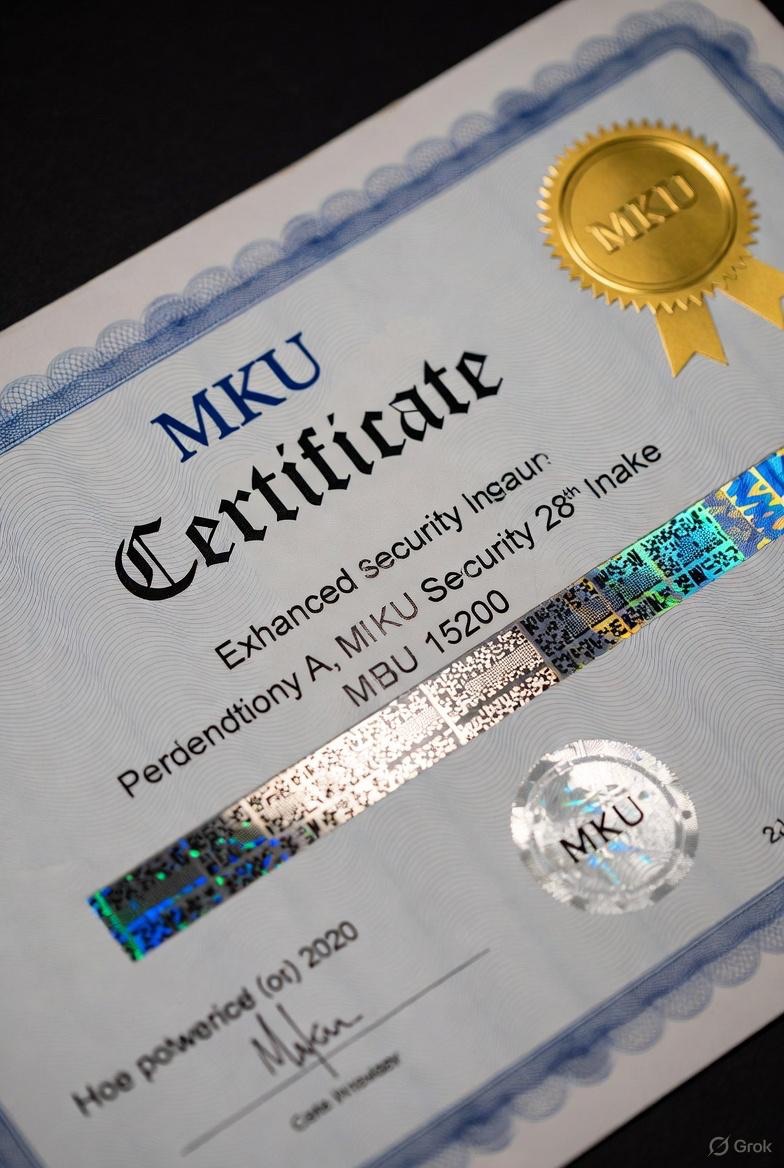
Mount Kenya University sparked a firestorm on Friday after attempting to showcase the security features on its graduation certificates, only for the move to revive long-running questions about the quality of education at the private institution.
The uproar began when MKU’s official X account posted an infographic during its 28th graduation ceremony.
The graphic, featuring a sample certificate for one “John James Hussein”, highlighted holograms, UV ink, QR codes and microtext meant to deter forgery. “MKU certificates come with enhanced security features to prevent forgery,” the caption read.

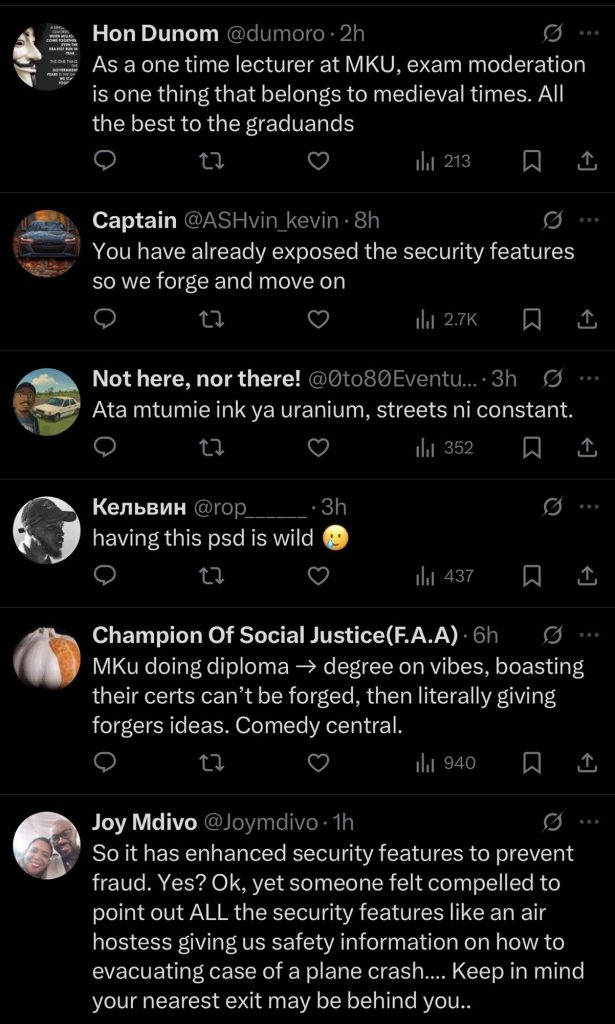
Instead of praise, the university was hit by a wave of derision. Within hours, the replies were piling up with accusations that MKU had ironically handed scammers a “how-to manual”.
Others went further, mocking the institution as a “diploma mill” and alleging it struggles more with internal academic fraud than external counterfeiting.
The backlash quickly morphed into a broader referendum on MKU’s credibility, with many questioning whether the university was more focused on protecting paper than improving learning.
One viral reply asked how students with D grades end up graduating with Bachelor’s degrees.
Another accused the university of rushing coursework, using imposters for exams and churning out graduates it wouldn’t hire itself.
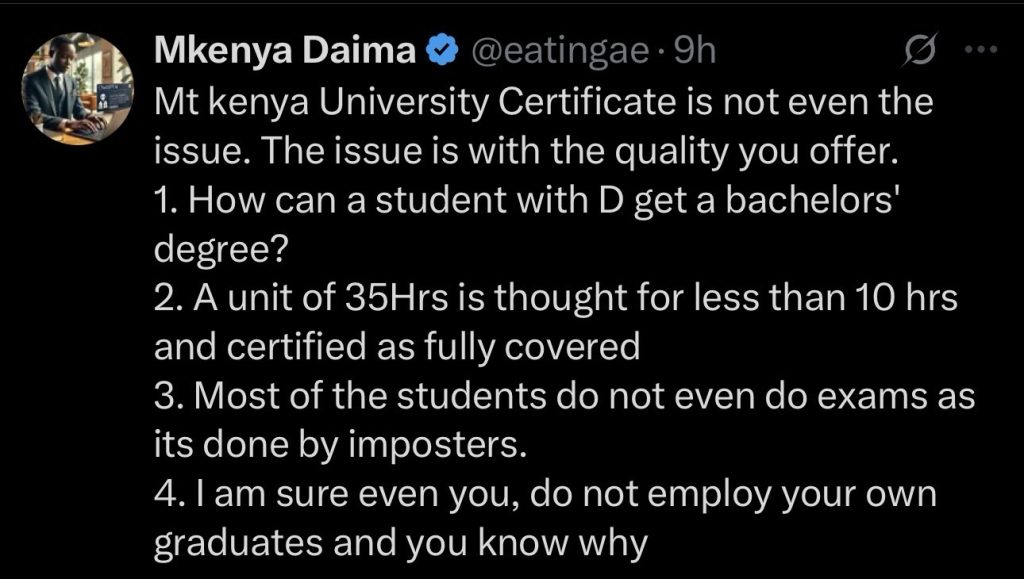
Employers joined the fray with anecdotes of bias against MKU alumni, saying some HR departments reject applications the moment they see the university’s name.
A widely shared graphic claimed 60 per cent of MKU graduates earn First Class or Second Class Upper honours, compared to public universities where most students graduate with Passes or Lower Second Class.
In some programmes, the university is producing more graduates than entire public universities do across all courses.
For many critics, the latest misstep only reopened old wounds.
In 2023, an EACC investigation revealed a suspect who used a forged MKU certificate to get a job at a different university.
The case fed a growing perception that private institutions are not doing enough to tighten verification, even as the country battles a booming fake-degree market.
Not everyone was critical.
A few users praised MKU’s efficiency, noting graduates can collect their certificates within days—something that can take months in public universities.
But even those rare compliments were drowned out by jokes, memes and comparisons with institutions like the University of Nairobi, which users claimed “would never post this kind of witchcraft.”
The episode has exposed deeper unease within Kenya’s higher education sector, where private universities have expanded rapidly as thousands of students scramble for limited opportunities.
Public universities struggle with delays, funding gaps and politics, while private ones face scrutiny over standards and admission practices.
MKU has not responded to the online backlash. But for the thousands of graduates set to collect their certificates next week, the debate has taken on a far more personal tone.
Many now fear the paper meant to open doors may instead trigger doubts they’ll have to work twice as hard to overcome.
There's no story that cannot be told. We cover the stories that others don't want to be told, we bring you all the news you need. If you have tips, exposes or any story you need to be told bluntly and all queries write to us [email protected] also find us on Telegram
